
TL;DR: Overseas procurement teams and plant engineers auditing Chinese activated carbon Certificates of Analysis (COAs) must account for China's precursor-split standard architecture. Coal-based granular and pellet carbons follow GB/T 7702, whereas wood-based and coconut-shell carbons follow GB/T 12496. By contrast, ASTM International uses unified material-agnostic test methods. While iodine number (
ASTM D4607vs.GB/T 7702.7/GB/T 12496.8) yields near-identical results when evaluated at a0.0200 mol/Lresidual filtrate normality, major numerical discrepancies occur in three areas: (1) methylene blue units, whereGB/T 12496.10reports milliliters of1.50 g/Lsolution per0.1 gcarbon (1.0 mL/0.1g = 15 mg/g, and1.0 mL/g = 1.5 mg/g); (2) mechanical hardness, whereGB/T 7702.3coal drum testing reads1.5 to 3.0 percentage pointshigher thanASTM D3802ball-pan hardness; and (3) ash ignition temperature, whereGB/T 7702.15combusts coal carbon at800 +/- 25 deg Cversus650 +/- 25 deg CinASTM D2866. At our Shizuishan manufacturing base, we issue dual-standard COAs verified across both ASTM and GB/T protocols.
| COA Parameter | ASTM International Standard | China Coal Carbon Standard (GB/T 7702) |
China Wood / Coconut Standard (GB/T 12496) |
Key Analytical Difference & Engineering Conversion Rule |
|---|---|---|---|---|
| Iodine Number | ASTM D4607 (mg/g) |
GB/T 7702.7 (mg/g) |
GB/T 12496.8 (mg/g) |
Equivalent (+/- 15 mg/g) only when corrected to residual filtrate concentration C = 0.0200 mol/L (0.0200 N). |
| Methylene Blue Value | AWWA B600 / CEFIC (mg/g) |
GB/T 7702.6 (mg/g or mL/0.1g) |
GB/T 12496.10 (mL/0.1g or mg/g) |
Standard dye solution is 1.50 g/L. Convert via MB (mg/g) = MB (mL/0.1g) * 15 = MB (mL/g) * 1.5. |
| Mechanical Hardness | ASTM D3802 Ball-Pan (%) |
GB/T 7702.3 Drum (%) |
GB/T 12496.6 Ball-Mill (%) |
GB/T 7702.3 coal drum reads 1.5% to 3.0% higher than ASTM D3802; specify ASTM D3802 for CIL/CIP gold and backwash beds. |
| CTC Vapor Activity | ASTM D3467 (wt%) |
GB/T 7702.13 (wt%) |
GB/T 12496.5 (wt%) |
Both pass CCl4-saturated dry air at 0 deg C through a 25.0 deg C carbon tube; CTC wt% = 2.55 * Butane Activity (ASTM D5742). |
| Total Ash Content | ASTM D2866 (wt% at 650 deg C) |
GB/T 7702.15 (wt% at 800 deg C) |
GB/T 12496.4 (wt% at 650 deg C) |
Coal ash tested at 800 deg C decomposes carbonates further, reading 0.3% to 0.8% lower than ASTM D2866 at 650 deg C. |
| Moisture (As Packed) | ASTM D2867 (wt% at 150 deg C) |
GB/T 7702.1 (wt% at 150 deg C) |
GB/T 12496.3 (wt% at 115 deg C) |
GB/T 12496.3 dries at 115 +/- 5 deg C for 3 to 4 h; ASTM D2867 dries at 150 deg C for 3 h (xylol distillation for impregnated grades). |
| Apparent / Bulk Density | ASTM D2854 (g/L or g/cm3) |
GB/T 7702.2 (g/L) |
GB/T 12496.1 (g/L) |
Vibratory feeder drop into a 100 mL cylinder (ASTM D2854) vs. funnel-pack drop; differences stay within +/- 15 g/L. |
| Particle Size / Sieve | ASTM D2862 (GAC) / D5158 (PAC) |
GB/T 7702.20 (Dry Sieve) |
GB/T 12496.2 (Dry / Wet Sieve) |
Verify US Standard Mesh (12x40 = 1.70 to 0.425 mm) vs. Chinese Taylor/GB mesh equivalents; use wet sieve for 325 Mesh PAC. |
| Water-Extractable pH | ASTM D3838 (Boiling Extract) |
GB/T 7702.16 |
GB/T 12496.7 |
ASTM D3838 boils 10 g carbon in 100 mL DI water for 900 s and measures filtrate at 50 deg C; GB/T cools filtrate to 25 deg C. |
| Caramel / Molasses Index | AWWA / Internal Molasses Number |
GB/T 7702.18 (Caramel) |
GB/T 12496.9 (Caramel A / B %) |
GB/T 12496.9 A-Grade Caramel >= 95% (98.5% typical) corresponds to Molasses Number 230 to 260 for large-molecule decolorization. |
GB/T 7702 vs. GB/T 12496 vs. ASTM International: How China's Dual Activated Carbon Standards Map to Global Specs
When North American, European, or Australian buyers request a Certificate of Analysis from an Asian factory, the first point of confusion is why two different Chinese national standard codes appear across product lines. In the United States and Europe, ASTM International (Committee D28 on Activated Carbon), AWWA (B600 for PAC and B604 for GAC), and EN (EN 12915 / EN 12903) define one test standard per physical property regardless of raw material.
China organizes its national testing standards (GB/T, meaning recommended national standards) by industrial ministry heritage and precursor feedstock:
GB/T 7702 is the Chinese national standard series governing test methods for coal-based granular, crushed, and extruded pellet activated carbons. Administered by the coal-chemical standardization committee, GB/T 7702.1 through GB/T 7702.22 specify apparatus geometries, muffle furnace temperatures (800 deg C for ash), and rotating drum attrition tests tailored to anthracite and bituminous coal chars.
GB/T 12496 is the Chinese national standard series governing test methods for wood-based, bamboo-based, and coconut-shell activated carbons. Administered by the forestry-chemical research institute in Nanjing, GB/T 12496.1 through GB/T 12496.22 cover phosphoric-acid and steam-activated powdered carbons (PAC) as well as microporous coconut shell granular carbons (GAC), including specialized assays for A-grade caramel decolorization (GB/T 12496.9) and acid-soluble iron (GB/T 12496.19).
As detailed in our ASTM activated carbon testing guide, neither Chinese system is inferior to ASTM. In fact, most wet-chemical procedures share identical stoichiometric roots. Procurement failures happen only when a buyer compares an unadjusted GB/T numerical value against an ASTM purchase order specification without checking the unit basis, residual filtrate concentration, or mechanical abrasion apparatus.
Why Do Methylene Blue Numbers Differ by 1.5x? Converting mL/0.1g, mL/g, and mg/g on Activated Carbon COAs
The single most frequent dispute in international activated carbon trade involves the Methylene Blue (MB) adsorption value on powdered activated carbon for decolorization and mesoporous coal-based granular activated carbon.
Methylene Blue Number is a liquid-phase assay that measures the volume or mass of methylene blue dye (C16H18ClN3S, molecular weight 319.85 g/mol, effective molecular diameter 1.5 nm) adsorbed per unit mass of activated carbon, serving as the primary indicator of mesopore development (2.0 to 5.0 nm).
Under GB/T 12496.10 (and historical GB/T 7702.6 reporting), the standard methylene blue test solution is prepared in a potassium dihydrogen phosphate (KH2PO4) and disodium hydrogen phosphate (Na2HPO4) buffer (pH 7.0) at an exact concentration of 1.50 g/L (1.50 mg/mL). During the test, the analyst weighs 0.100 g of dried carbon into a conical flask and titrates increments of this 1.50 g/L dye solution until the filtrate optical absorbance matches a 0.004 g/L reference standard at a spectrophotometer wavelength of 665 nm.
Because the Chinese standard protocol uses a 0.100 g carbon dose and a 1.50 mg/mL solution concentration, Chinese domestic COAs frequently express the result in milliliters of dye solution decolorized per 0.1 g of carbon (mL/0.1g) or milliliters per gram (mL/g), whereas international buyers specify milligrams of dye adsorbed per gram of carbon (mg/g). The exact stoichiometric conversion equations are:
- Concentration of GB/T standard dye solution:
C_MB = 1.50 g/L = 1.50 mg/mL - From
mL/0.1gtomL/g:MB (mL/g) = MB (mL/0.1g) * 10 - From
mL/0.1gtomg/g:MB (mg/g) = MB (mL/0.1g) * 10 * 1.50 mg/mL = MB (mL/0.1g) * 15 - From
mL/gtomg/g:MB (mg/g) = MB (mL/g) * 1.50
Worked Methylene Blue Conversion Table for Procurement Audits
Use the table below when comparing Chinese domestic mill sheets against international mg/g specifications on our Technical Data Sheets (TDS) hub:
GB/T 12496.10 Reading (mL/0.1g) |
Volume per Gram (mL/g of 1.5 g/L Dye) |
International Mass Basis (mg/g) |
Typical DXD Carbon Grade & Target Application |
|---|---|---|---|
8.0 mL/0.1g |
80 mL/g |
120 mg/g |
Standard Coal-Based GAC (800 to 900 Iodine) for municipal water filtration (AWWA B604). |
10.0 mL/0.1g |
100 mL/g |
150 mg/g |
High-activity Coal GAC (950 to 1,050 Iodine) and base Wood-Based PAC for wastewater COD polishing. |
12.0 mL/0.1g |
120 mL/g |
180 mg/g |
Pharmaceutical & food-grade Wood PAC (cross-referenced to Norit Darco G-60 / Jacobi ColorSorb G5). |
13.0 mL/0.1g |
130 mL/g |
195 mg/g |
DXD Flagship Decolorization PAC (Illustrative COA: 195 mg/g, Caramel A-Grade 98.5%). |
14.7 mL/0.1g |
147 mL/g |
220 mg/g |
Ultra-mesoporous phosphoric-acid Wood PAC for high-color fermentation broths, citric acid, and amino acids. |
Watch for two opposite procurement traps during bid evaluations:
- Trap 1 (False Rejection): A factory technician writes
Methylene Blue: 13 mL/0.1gon a Chinese COA. An overseas buyer looking for>= 180 mg/grejects the sample, not realizing that13 mL/0.1g * 15 = 195 mg/gexceeds their specification by15 mg/g. - Trap 2 (Unit Inflation by Unverified Brokers): A trading broker takes a low-grade carbon that tested at
120 mL/g(12.0 mL/0.1g, which equals180 mg/g) or100 mL/g(150 mg/g) and changes the unit label on a re-typed Word document frommL/gtomg/g, or vice versa, inflating a120 mg/gcoal carbon (80 mL/g) into a claimed "180value" without specifying units. Always mandate explicitmg/gunits on the COA and ask for the equilibrium spectrophotometer absorbance check at665 nm.
Iodine Number (ASTM D4607 vs. GB/T 7702.7 / GB/T 12496.8) and Mechanical Hardness (ASTM D3802 vs. GB/T 7702.3)
1. Why Single-Point Iodine Shortcuts Drift from Three-Point ASTM D4607 Isotherms
Both ASTM D4607 and the Chinese national standards (GB/T 7702.7 for coal carbon and GB/T 12496.8 for wood/coconut carbon) define iodine number identically: the milligrams of iodine (I2) adsorbed by 1.000 g of pulverized activated carbon (>= 95 wt% passing 325 US Mesh / 45 um) when the residual iodine concentration (C) in the equilibrium filtrate is exactly 0.0200 mol/L (0.0200 N of 1/2 I2).
In all three standards, the pulverized carbon is boiled for 30.0 seconds with 10.0 mL of 5 wt% hydrochloric acid (HCl) to wet the micropores and decompose sulfur or alkaline surface oxides, cooled to room temperature, shaken with 100.0 mL of 0.1000 mol/L (0.1000 N) standard iodine solution, filtered swiftly through dry filter paper, and back-titrated with 0.1000 mol/L sodium thiosulfate (Na2S2O3) using soluble starch indicator.
Where discrepancies arise is between three-point logarithmic interpolation (ASTM D4607) and single-point correction-factor (D-table) testing:
- Under strict
ASTM D4607, three separate carbon weights (m1, m2, m3) are dosed so that their equilibrium filtrate normalities (C) bracket0.0200 Nwithin the permissible range of0.0080 N <= C <= 0.0400 N. The analyst plotslog(X/M)againstlog(C)and interpolates the exactX/Mvalue atC = 0.0200 N. - In rapid single-point factory checks (allowed in
GB/T 7702.7andGB/T 12496.8routine shift inspections), one carbon weight (0.500 gto0.900 g) is shaken with50.0 mLor100.0 mLof iodine solution, and the measuredX/Mat residual concentrationCis multiplied by a tabulated empirical correction factorD. - Audit Rule: When
Cfalls tightly between0.0180 mol/Land0.0220 mol/L,GB/T 7702.7,GB/T 12496.8, andASTM D4607agree within+/- 10 to 15 mg/g. However, if a technician overdoses carbon so that residualCdrops below0.0100 mol/L(0.0100 N), applying a linear coalD-factorto a highly microporous coconut shell carbon can overstate the trueASTM D4607iodine number by25 to 45 mg/g. For every export lot, require the laboratory to record the actual residual filtrate normalityC(0.0080 to 0.0350 N) alongside the reported iodine number.
2. Mechanical Hardness: ASTM D3802 Ball-Pan vs. GB/T 7702.3 Rotating Drum
Ball-Pan Hardness Number (ASTM D3802) is the mass percentage of granular or pelletized activated carbon retained on a designated US Standard sieve after a 100 mL screened sample is subjected to 30 minutes of combined cam-driven horizontal shaking and vertical tapping with 15 steel balls of 12.7 mm (1/2 in.) diameter and 15 steel balls of 9.5 mm (3/8 in.) diameter inside a hardened steel pan.
By contrast, GB/T 7702.3 measures coal carbon wear resistance (Strength %) by placing 50 mL of screened sample and 5 steel balls (14.3 mm diameter) inside a cylindrical steel drum (90 mm inner diameter) rotating at 50 +/- 2 rpm for 15 minutes (750 revolutions). Because GB/T 7702.3 omits the vertical Ro-Tap hammer impact blow and runs for half the duration with fewer grinding balls, its numerical reading is systematically higher on brittle coal matrices:
- Bituminous Coal GAC (
8x30or12x40Mesh): A batch testing at93.5% to 95.0%underGB/T 7702.3typically measures90.5% to 92.5%underASTM D3802ball-pan hardness (and80% to 85%underAWWA B604stirred abrasion). - Extruded Pellet Carbon (
3.0 mmor4.0 mm): High-pressure pitch/coal extruded pellets measure96.0% to 97.5%onGB/T 7702.3and95.0% to 96.5%onASTM D3802. - Gold Recovery Coconut Shell GAC (
6x12or8x16Mesh): Dense coconut shell char has high impact elasticity, soGB/T 12496.6andASTM D3802converge much more closely (97.5% to 99.0%). Even so, hydrometallurgical gold mines operating CIL/CIP/CIC circuits should always specifyASTM D3802 >= 98.0%(DXD batch COA: 98.7%) to prevent gold-loaded fine losses through0.7 to 0.8 mminterstage screens.
3. Total Ash (650 deg C vs. 800 deg C), Moisture, and Water-Extractable pH
Three additional laboratory temperature differences explain minor COA variations between Chinese and American test reports:
- Ash Ignition Temperature (
ASTM D2866vs.GB/T 7702.15vs.GB/T 12496.4):ASTM D2866andGB/T 12496.4(wood/coconut) ignite carbon in a muffle furnace at650 +/- 25 deg Cto constant weight. However,GB/T 7702.15(coal carbon) ignites the sample at800 +/- 25 deg C. Between650 deg Cand800 deg C, residual calcium carbonate (CaCO3 -> CaO + CO2) and magnesium minerals in coal ash undergo thermal decomposition, releasingCO2gas. Consequently, a coal GAC lot that reports10.2 wt%ash underGB/T 7702.15(800 deg C) may report10.7 to 11.0 wt%ash underASTM D2866(650 deg C). If your contract ceiling is strictly<= 12.0 wt%(ASTM D2866), specify650 deg Cmuffle ignition on the purchase order. - Oven Drying Temperature for Moisture (
ASTM D2867vs.GB/T 12496.3): BothASTM D2867andGB/T 7702.1dry granular carbon in a convection oven at150 +/- 5 deg Cfor3 hours, whereasGB/T 12496.3dries wood and coconut carbons at115 +/- 5 deg Cfor3 to 4 hours. Drying at150 deg Cremoves slightly more tightly bound pore moisture (0.2% to 0.5%difference). Note that for chemically impregnated carbons (KOH,KI, or sulfur pellets used in industrial gas treatment), both standards require xylene azeotropic distillation (ASTM D2867xylene method) so volatile impregnants are not miscounted as moisture. - Water-Extractable pH Temperature (
ASTM D3838vs.GB/T 7702.16/GB/T 12496.7): Both methods boil10.0 gof carbon in100 mLof CO2-free distilled water (900 sreflux inASTM D3838,300 sgentle boil inGB/T). However,ASTM D3838filters the hot slurry and measures pH at50 +/- 5 deg C, whereasGB/Tcools the filtrate to25 +/- 2 deg C. Because water dissociation (Kw) increases with temperature, neutral-to-alkaline steam-activated carbons (pH 9.0 to 10.5) read0.2 to 0.4 pH unitslower at50 deg Cthan at25 deg C.
Dual-Standard ASTM and GB/T Batch COA Verification Across All Six DXD Carbon Product Lines
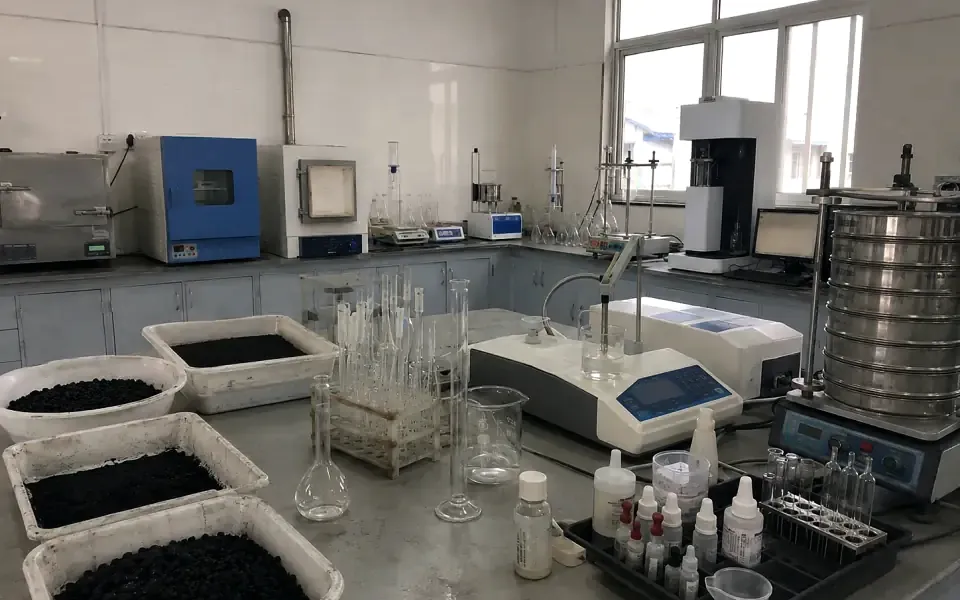
At our 50,050 m2 manufacturing base in Shizuishan, Ningxia (Ningxia Yongruida Carbon Co., Ltd., established in 1990 with 10,000+ MT/yr annual output), our plant quality control laboratory is equipped with both ASTM D3802 Ro-Tap ball-pan shakers and GB/T 7702.3 rotating drums, 650 deg C and 800 deg C programmable muffle furnaces, UV-Vis spectrophotometers (665 nm for methylene blue and 610 nm for caramel), and 0.0200 N three-point iodine isotherm titration benches.
When you source bulk activated carbon through our export center (Henan Dingxinda Import & Export Co., Ltd.), every pre-shipment sample and full-container-load (20GP or 40HQ) COA reports the exact test method alongside the measured batch value across all six core product lines on our products hub:
| DXD Carbon Product Line | Target Applications | Typical ASTM Specification & COA Reference | Typical GB/T Crosswalk Reference | Packaging & FCL Loading |
|---|---|---|---|---|
Coal-Based Granular Activated Carbon (8x30, 12x40 Mesh) |
Municipal water treatment, PFAS/TOC removal, wastewater filtration | Iodine 800-1,050 mg/g (ASTM D4607), Ball-Pan Hardness >= 90.0-93.0% (ASTM D3802), Ash <= 12.0% (ASTM D2866 at 650 deg C), Moisture <= 5.0% (ASTM D2867). |
GB/T 7702.7 Iodine 800-1,050 mg/g, GB/T 7702.6 MB 120-200 mg/g (8.0-13.3 mL/0.1g), GB/T 7702.3 Drum Strength >= 92-95%. |
25 kg PP/Kraft bags or 500/1,000 kg FIBC (20-24 MT / 40HQ). |
Coconut Shell Granular Activated Carbon (8x30, 12x40, 20x40 Mesh) |
Drinking water (NSF/ANSI 61 / AWWA B604), RO dechlorination, VOC scrubbing |
Iodine 950-1,100+ mg/g (ASTM D4607), Hardness >= 95.0-98.0% (ASTM D3802), Ash <= 3.0-5.0% (ASTM D2866), Acid-Washed pH 6.5-8.0 (ASTM D3838). |
GB/T 12496.8 Iodine 950-1,100+ mg/g, GB/T 12496.6 Strength >= 96-98%, GB/T 12496.4 Ash <= 3.0-5.0%. |
25 kg bags or 500 kg super sacks (9-11 MT / 20GP). |
Activated Carbon for Gold Recovery (6x12, 6x16, 8x16 Mesh) |
CIP, CIL, and CIC gold cyanidation circuits | Iodine 1,050-1,150+ mg/g (ASTM D4607), Ball-Pan Hardness >= 97.5-99.0% (98.7% illustrative COA, ASTM D3802), CTC >= 55% (ASTM D3467), Undersize < 12/16 Mesh <= 3.0 wt% (1.4 wt% typical, ASTM D2862). |
GB/T 12496.8 Iodine 1,050-1,150+ mg/g, GB/T 12496.5 CTC >= 55%, Apparent Density 480-530 g/L (GB/T 12496.1). |
500 kg / 1,000 kg UV-stabilized FIBCs on fumigated pallets. |
Pellet Activated Carbon (1.5 mm, 3.0 mm, 4.0 mm, 6.0 mm) |
VOC air purification, solvent recovery, biogas H2S scrubbing (KOH/KI) |
CTC 50-80% (ASTM D3467), Butane Working Capacity BWC >= 23.0 wt% (ASTM D5742), Iodine 700-1,100 mg/g (ASTM D4607), Hardness >= 95.0-97.0% (ASTM D3802). |
GB/T 7702.13 CTC 50-80%, GB/T 7702.3 Drum Strength >= 96.0%, Bulk Density 460-520 g/L (GB/T 7702.2). |
25 kg PE-lined bags or 500 kg bulk bags. |
Powdered Activated Carbon for Decolorization (200 / 325 Mesh) |
Food, sugar, citric acid, MSG & API decolorization | Methylene Blue 150-220 mg/g (195 mg/g typical), Iodine 800-1,050 mg/g (ASTM D4607), Wet Sieve >= 95% passing 200/325 Mesh (ASTM D5158), Ash <= 5.0 wt% (ASTM D2866). |
GB/T 12496.10 MB 10.0-14.7 mL/0.1g (150-220 mg/g), GB/T 12496.9 A-Grade Caramel >= 95.0% (98.5% typical), GB/T 12496.19 Acid-Soluble Iron Fe <= 0.02-0.05 wt%. |
20/25 kg kraft-composite bags with PE liner (18-20 MT / 40HQ). |
Wood-Based Powdered Activated Carbon (200 / 325 Mesh) |
Process liquids, pharmaceutical intermediates, potable water PAC dosing | Iodine 800-1,050 mg/g (ASTM D4607), Methylene Blue 120-200 mg/g, Fineness 90-95% (ASTM D5158), Bulk Density 250-450 g/L (ASTM D2854). |
GB/T 12496.8 Iodine 800-1,050 mg/g, GB/T 12496.10 MB 8.0-13.3 mL/0.1g, GB/T 12496.7 pH 4.0-7.0 (phosphoric) or 8.0-10.0 (steam). |
20/25 kg bags or 400-500 kg FIBC super sacks. |
For buyers replacing international catalog grades, our Calgon, Norit, and Jacobi cross-reference guide maps these dual-standard specifications directly to legacy Western datasheets.
How Do You Audit a Chinese Activated Carbon COA Before FCL Container Shipment?
Before releasing final payment or booking ocean freight for a 20GP (9 to 11 MT) or 40HQ (20 to 24 MT) container (as outlined in our bulk activated carbon buying guide), apply this five-step engineering verification checklist to every supplier COA:
- Verify Standard Code Alignment with Raw Material: Confirm that coal-based granular or pellet carbon COAs cite
ASTMorGB/T 7702.*methods, and wood or coconut shell COAs citeASTMorGB/T 12496.*methods. If a supplier submits a coconut shell GAC report citingGB/T 7702.3coal drum hardness or800 deg Ccoal ash (GB/T 7702.15), flag the document as a copy-pasted template. - Audit Exact Units and Equilibrium Concentration (
C = 0.0200 N): Check that iodine number is stated inmg/gat residual filtrate normalityC = 0.0200 mol/L(ASTM D4607) and that methylene blue is explicitly reported inmg/g(1.0 mL/0.1g = 15 mg/g). - Check Guaranteed Min/Max Column vs. Actual Batch Test Result: Reject COAs where the "Test Result" column simply repeats the "Specification" range (
e.g., Spec: >= 1,000 mg/g | Result: >= 1,000 mg/g). A valid laboratory COA must report discrete measured integers or decimals (e.g., Iodine: 1,058 mg/g,Moisture: 3.4 wt%,Ball-Pan Hardness: 98.7%) tied to a traceable kiln lot number (Lot No.). - Match Regulatory and Industry Benchmarks: For potable water treatment, verify alignment with US EPA drinking water regulations (
AWWA B600/AWWA B604) and US EPA PFAS guidance. For vapor-phase scrubbers, cross-check bed velocity and butane working capacity against US EPA Clean Air Technology Center technical bulletins. For food and pharmaceutical decolorization, verify acid-soluble ash, iron (Fe <= 0.02%), and heavy metal limits against US FDA food additive purity frameworks. - Lock a Pre-Shipment Sealed Retention Sample (
500 g): Require300 to 500 gcomposite lot samples drawn across>= 10%of the filled25 kgbags or500/1,000 kgFIBCs prior to container stuffing, enabling side-by-side verification by SGS, Intertek, or your plant laboratory. To request a dual-standardASTM + GB/Tsample kit and batch COA for your facility, reach our engineering team via our contact page.