
Industrial air pollution control systems must capture volatile organic compounds (VOCs), siloxanes, and hydrogen sulfide without overloading exhaust blowers. Environmental engineers designing fixed-bed adsorbers under the U.S. EPA Clean Air Act stationary source framework often see premature solvent breakthrough or high pressure drop. That happens when purchase orders specify "activated carbon pellets" without locking in cylinder diameter and carbon tetrachloride (CTC) activity. Putting a 1.5 mm pellet into a 1.5-meter deep bed triples fan static pressure. Loading an 8.0 mm pellet into a thin panel filter lets solvent vapors slip straight through the void channels.
Our adsorption process engineers and quality team at the DXD Carbon Shizuishan plant and lab (50,050 m2 site, 10,000+ MT/year) compiled this guide. It covers diameter selection, Ergun pressure drop curves, ASTM vapor testing, and humidity limits. Process engineers can check our extruded pellet activated carbon product line. Bulk buyers can also review our air purification application guide and industrial gas treatment solutions.
| Pellet Diameter | Cylinder Length | Typical Bed Depth (H_bed) | Design Gas Velocity (v) | Clean-Bed Pressure Drop (@ 0.30 m/s) | Primary Industrial Gas & VOC Application |
|---|---|---|---|---|---|
| 1.5 mm / 2.0 mm | 3.0 to 6.0 mm | 0.05 to 0.30 m | 0.10 to 0.25 m/s | 1,850 to 2,600 Pa/m | Respirator cartridges, cabin air filters, laboratory fume hoods |
| 3.0 mm | 4.0 to 8.0 mm | 0.40 to 0.90 m | 0.15 to 0.35 m/s | 920 to 1,250 Pa/m | Paint spray booths, printing exhaust, commercial odor scrubbers |
| 4.0 mm | 5.0 to 10.0 mm | 0.80 to 1.80 m | 0.20 to 0.45 m/s | 580 to 780 Pa/m | Deep-bed VOC solvent recovery, biogas H2S and siloxane towers |
| 6.0 mm / 8.0 mm | 6.0 to 14.0 mm | 1.00 to 2.00 m | 0.30 to 0.50 m/s | 240 to 410 Pa/m | High-volume sewage odor vents, low-static-pressure exhaust ducts |
Why Cylinder Diameter Controls Both Mass Transfer and Fan Power
Extruded pellet activated carbon is a cylindrical adsorbent extruded from pulverized coal or charcoal mixed with a binder and steam-activated at 850 to 1,000 degrees Celsius. Before activation, we mill the raw coal to pass a 200-mesh screen, press it through 1.5 to 8.0 mm steel dies, and carbonize the rods at 450 to 600 degrees Celsius. Unlike irregular crushed granular carbon, uniform pellets pack into fixed vessels with an even void fraction of 38% to 44%. That uniform geometry stops gas channeling and lowers airflow resistance by 30% to 45% compared with crushed granules.
Selecting the cylinder diameter balances external film diffusion against bed head loss. Smaller 1.5 mm and 2.0 mm pellets provide a high geometric surface area per cubic meter of bed (a_v = 6 * (1 - epsilon) / d_p). That high surface area forms a short mass transfer zone (MTZ) of 30 to 80 mm. It stops vapor bleed-through in thin canister filters with empty bed contact times (EBCT) of 0.3 to 1.0 seconds.
Larger 4.0 mm, 6.0 mm, and 8.0 mm pellets widen the flow channels between cylinders, cutting frictional drag at high gas flow rates. Gas molecules must diffuse further from the cylinder exterior to the core micropores. As a result, 4.0 mm pellets need a deeper bed (0.8 to 1.8 meters) and a 2.0 to 6.0 second EBCT to hold the mass transfer zone. Matching pellet diameter to vessel depth prevents fan overload and stack emission spikes under U.S. EPA air emissions monitoring guidelines.
Bed Pressure Drop Hydraulics and Superficial Gas Velocity
Superficial gas velocity is the volumetric gas flow rate (Q in m3/s) divided by the empty vessel cross-sectional area (A in m2), expressed in meters per second (v = Q / A). In imperial units, 1.0 m/s equals 196.85 ft/min. Industrial VOC and biogas vessels typically run at superficial velocities between 0.15 and 0.50 m/s (30 to 100 ft/min). Operating below 0.10 m/s risks uneven gas flow across wide horizontal beds, whereas exceeding 0.55 m/s in upflow towers can fluidize and abrade the top carbon layer.
Pressure drop per meter of bed depth (dP / L, in Pa/m) follows the Ergun equation. That formula adds viscous laminar loss (proportional to v / d_p^2) and turbulent kinetic loss (proportional to rho * v^2 / d_p). At industrial gas velocities of 0.25 to 0.45 m/s, the turbulent kinetic term dominates. Increasing pellet diameter from 2.0 mm to 4.0 mm cuts bed pressure drop by more than 60% at the same airflow rate.
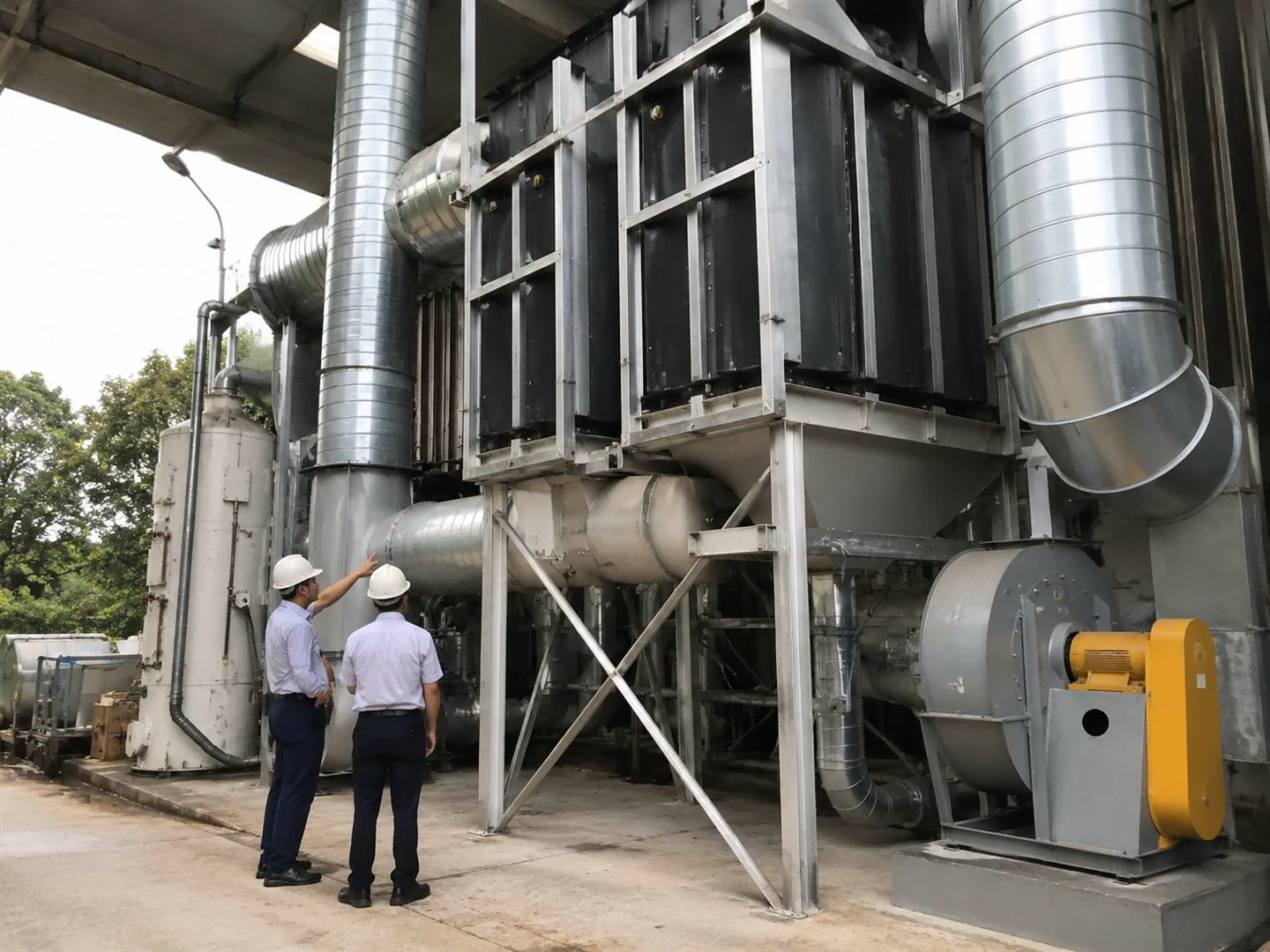
- 1.5 mm and 2.0 mm Pellets: Designed for thin-bed V-bank modules, cartridge filters, automotive cabin units, and organic vapor respirators. Keep superficial velocity between 0.10 and 0.25 m/s and bed depth under 0.30 meters so total vessel pressure drop stays below 600 Pa.
- 3.0 mm Pellets: The preferred intermediate size for spray-booth exhaust, rotogravure printing vents, and modular radial-flow canisters. At 0.30 m/s and a 0.60-meter bed depth, clean-bed pressure drop averages 550 to 750 Pa (2.2 to 3.0 in. w.c.).
- 4.0 mm Pellets: The global industry workhorse for deep fixed-bed VOC scrubbers, steam-desorption solvent recovery plants, and biogas desulfurization towers. A 1.2-meter deep bed running at 0.30 m/s generates only 700 to 930 Pa of static resistance, allowing standard medium-pressure centrifugal fans to operate efficiently.
- 6.0 mm and 8.0 mm Pellets: Engineered for high-flow municipal wastewater lift stations, composting bio-filters, and retrofit ducts. They fit sites where axial or low-static fans cannot overcome more than 300 to 500 Pa of media resistance.
| Superficial Gas Velocity (v) | 1.5 mm Pellet (Pa/m) | 3.0 mm Pellet (Pa/m) | 4.0 mm Pellet (Pa/m) | 6.0 mm Pellet (Pa/m) | Typical Vessel Configuration |
|---|---|---|---|---|---|
| 0.15 m/s (30 ft/min) | 820 Pa/m | 360 Pa/m | 230 Pa/m | 110 Pa/m | Shallow canisters, high-concentration solvent traps |
| 0.25 m/s (50 ft/min) | 1,640 Pa/m | 710 Pa/m | 450 Pa/m | 210 Pa/m | Standard vertical fixed-bed VOC and H2S scrubbers |
| 0.30 m/s (60 ft/min) | 2,150 Pa/m | 980 Pa/m | 640 Pa/m | 290 Pa/m | Municipal odor control, printing & coating exhaust |
| 0.40 m/s (80 ft/min) | 3,380 Pa/m | 1,560 Pa/m | 1,040 Pa/m | 470 Pa/m | Deep-bed solvent recovery, lead-lag industrial towers |
| 0.50 m/s (100 ft/min) | Not recommended | 2,290 Pa/m | 1,520 Pa/m | 690 Pa/m | High-throughput flue gas & axial-fan duct scrubbers |
Specifying ASTM D3467 CTC Activity and ASTM D5742 Butane Working Capacity
Liquid-phase iodine number (ASTM D4607) is an incomplete proxy for gas-phase pellets because vapor adsorption depends on total micropore and fine-mesopore volume at gas saturation pressures. Our ASTM activated carbon laboratory testing guide covers vapor test methods in detail. Gas-phase purchase orders should anchor on carbon tetrachloride (CTC) activity and butane working capacity (BWC).
Carbon tetrachloride (CTC) activity is the maximum weight percentage of saturated carbon tetrachloride vapor adsorbed by dry activated carbon at 25 degrees Celsius under ASTM D3467. Standard industrial VOC pellets specify a minimum CTC of 55% to 60% wt (with our representative 4.0 mm batch testing at 63.5% wt on our online TDS and COA center). High-energy solvent recovery and siloxane abatement grades are steam-activated longer to reach 70% to 80% CTC activity.
Butane working capacity (BWC) is the mass of n-butane adsorbed per 100 mL (or 100 g) of carbon at saturation minus the butane retained after a dry air purge under ASTM D5228 and ASTM D5742. Because the Montreal Protocol restricts carbon tetrachloride in labs, ASTM D5742 butane activity (Butane Activity % * 2.55 ≈ CTC %) serves as the modern test standard. A butane activity of 23.5% to 25.5% wt matches a 60% to 65% CTC rating. In steam-regenerated solvent recovery plants (ethyl acetate, toluene, hexane), a high BWC (>= 23.0 wt%, batch result 24.8 wt%) ensures that trapped solvent releases cleanly during steam stripping.
Controlling Relative Humidity, Ketone Exotherms, and Impregnated Pellets
Physical adsorption of non-polar VOCs (benzene, toluene, xylene, chlorinated solvents, and siloxanes D4 and D5) inside virgin micropores is sensitive to moisture. When exhaust relative humidity (RH) exceeds 65% to 70%, water molecules condense inside pores wider than 1.2 nm. That condensed water film blocks hydrophobic organic vapors described in U.S. EPA volatile organic compound technical summaries and cuts toluene or ethyl acetate capacity by 40% to 60%.
- Physical VOC Adsorption (< 65% RH, < 40 C): Install an upstream demister pad and a finned pre-heater to raise exhaust gas temperature by 5 to 8 degrees Celsius. That slight heat boost drops relative humidity from 85% RH to below 55% RH. Always pair it with MERV 13 (EN 779 F7) pre-filters to stop paint overspray from blinding the pellets.
- Ketone and Aldehyde Exothermic Safety: Methyl ethyl ketone (MEK), cyclohexanone, and acetaldehyde release high heats of adsorption and can oxidize on alkaline ash surfaces. For ketone streams, specify low-ash or acid-washed pellets with an ignition point above 380 to 420 degrees Celsius. Eliminate dead-air zones and install multi-level temperature RTDs with nitrogen or water deluge nozzles.
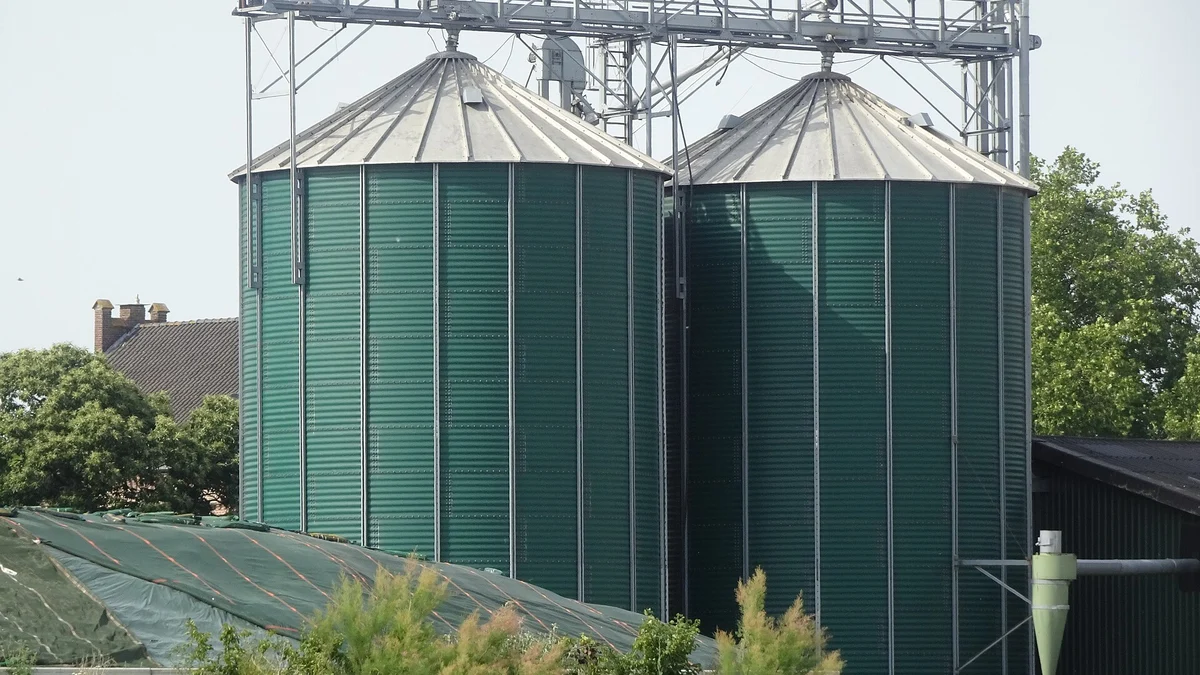
- Chemisorption with Impregnated Pellets: Acidic and reactive gases such as hydrogen sulfide (
H2S), sulfur dioxide (SO2), mercaptans, and elemental mercury (Hg0) show weak physical adsorption on virgin carbon. Our Shizuishan plant impregnates 3.0 mm and 4.0 mm mesoporous pellets (>= 60% CTCbase) withKOH,NaOH,KI, or elemental sulfur. CatalyticH2Soxidation onKOHorKIpellets works best at 40% to 80% RH and 0.5% to 2.0% oxygen, locking sulfur into the pores (>= 0.15 to 0.25 g H2S / cm3capacity).
Specifying DXD Extruded Pellet Activated Carbon Grades
At our 50,050 m2 manufacturing base in Shizuishan, Ningxia (10,000+ MT/year output since 1990), we produce virgin and impregnated extruded pellets. Standard die sizes cover 1.5 mm, 2.0 mm, 3.0 mm, 4.0 mm, 6.0 mm, and 8.0 mm diameters. Every lot undergoes high-pressure extrusion, rotary carbonization (450 to 600 degrees Celsius), and controlled steam activation (850 to 1,000 degrees Celsius). Before shipment, our lab checks caliper diameter, ASTM D3467 CTC activity, ASTM D5742 butane activity, ASTM D4607 iodine, ASTM D3802 hardness, ASTM D2867 moisture, and ASTM D2854 density.
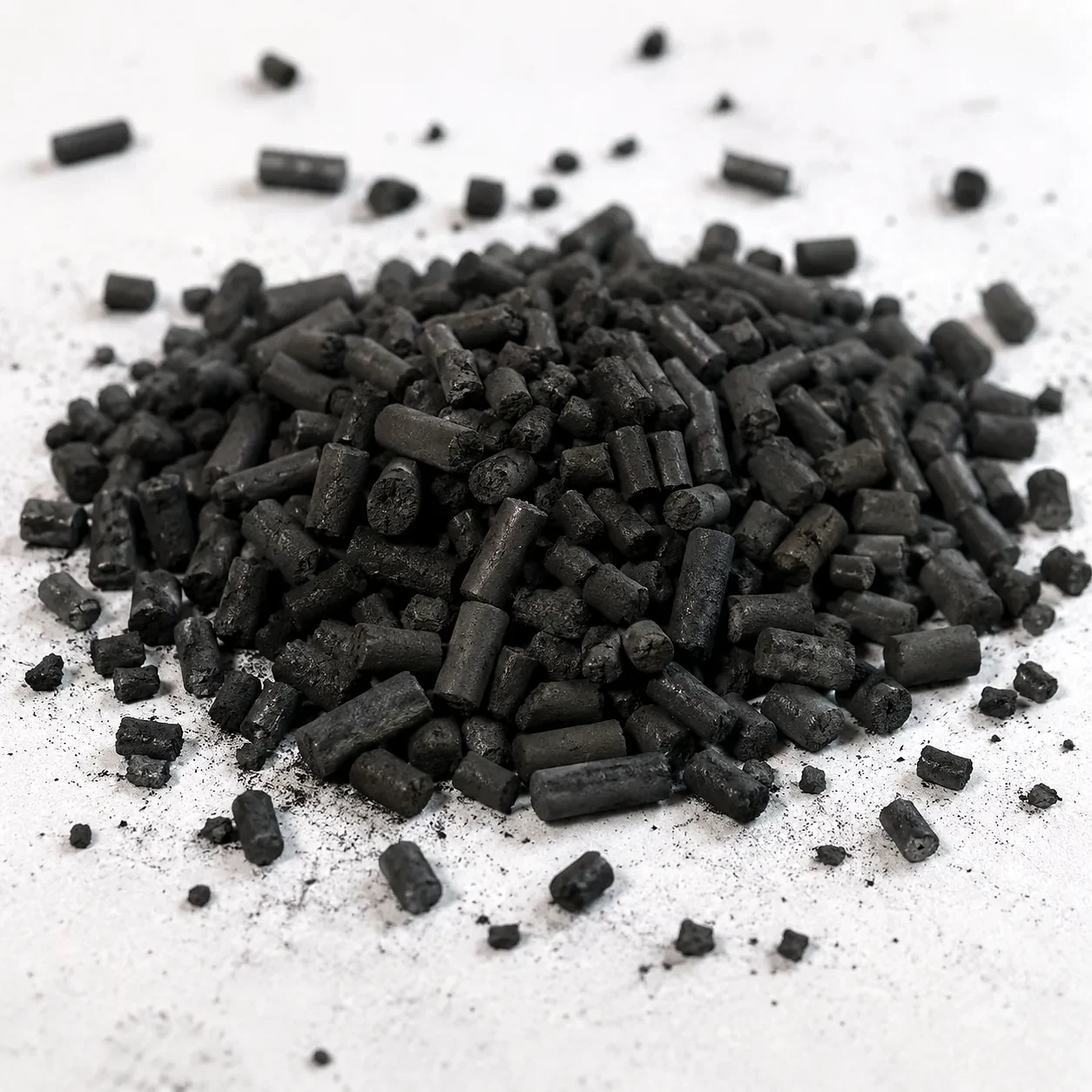
Our virgin extruded pellet activated carbon is a direct specification replacement for Calgon AP4-60 and BPL, Norit RB 3 and RB 4, and Jacobi EcoSorb GX. Standard 3.0 mm and 4.0 mm VOC grades supply >= 60% CTC activity (configurable from 50% to 80% CTC), >= 950 mg/g iodine, and >= 23% butane working capacity. They hold 95.0% to 97.0% ball-pan hardness at an apparent density of 460 to 520 g/L (batch test: 488 g/L).
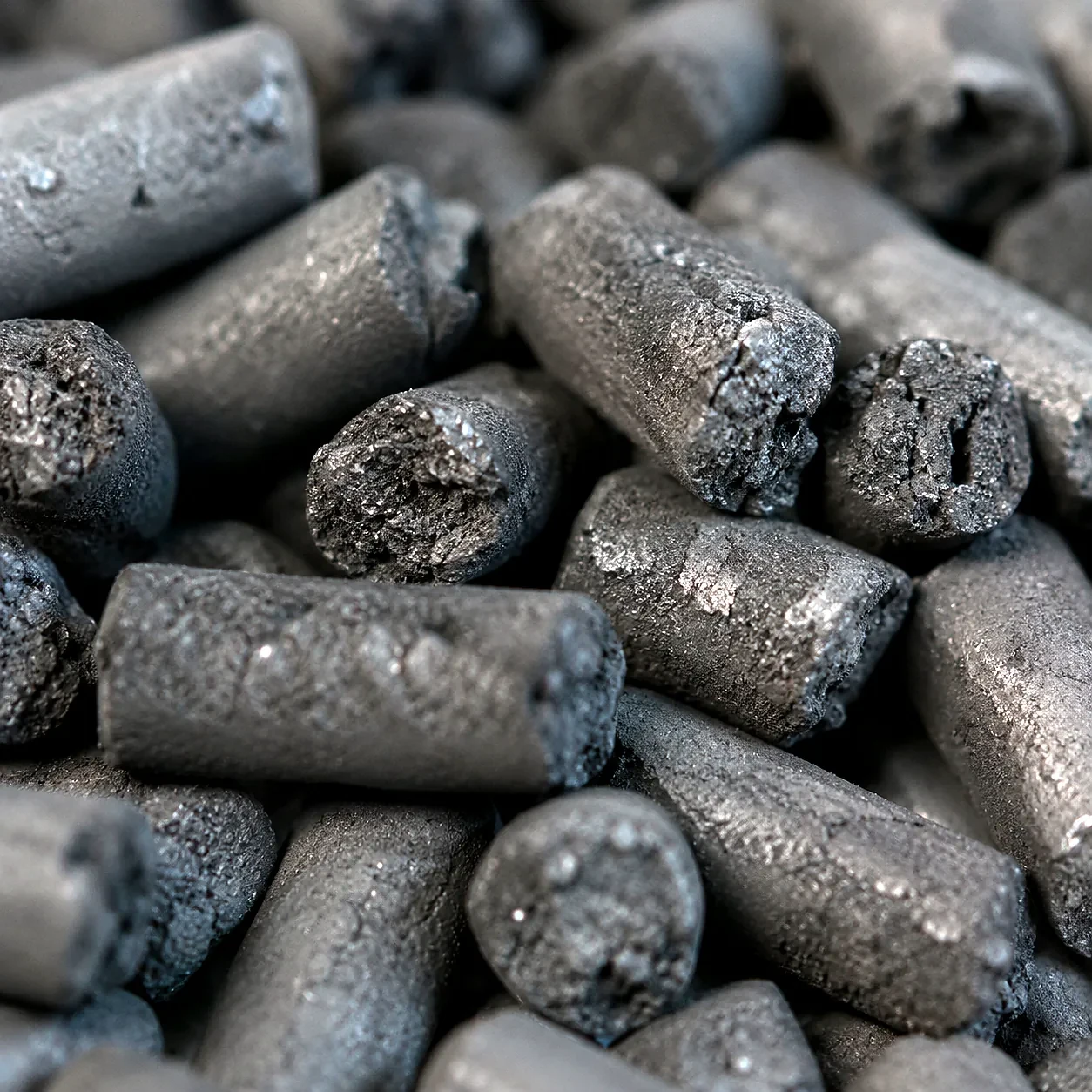
For biogas digesters, sewage odor scrubbers, and natural gas mercury guard beds, our impregnated pellets match Norit RGM and R 2030, Jacobi AddSorb Sulfox and AddSorb MGR, and Calgon Centaur and HGR grades. Buyers can check full brand mappings in our Calgon, Norit, and Jacobi cross-reference guide. We pack export orders in 25 kg PE-lined bags or 500 kg and 1,000 kg bottom-spout FIBC super sacks (9 to 11 MT per 20GP or 20 to 24 MT per 40HQ). See our bulk activated carbon buying guide or contact our engineering desk for a batch COA and sample.
| Bulk Manufacturing Grade | International Brand Equivalent | Pellet Diameter | CTC Activity (ASTM D3467) | Hardness (ASTM D3802) | Impregnation | Primary Gas-Phase Application |
|---|---|---|---|---|---|---|
| Standard Virgin Coal Pellet (60% CTC) | Calgon AP4-60 / Norit RB 3 & RB 4 / Jacobi EcoSorb GX | 3.0 mm, 4.0 mm | >= 60% (Batch: 63.5%) | >= 95% (Batch: 96.8%) | Virgin Coal | Paint booths, BTEX, printing VOCs, siloxanes |
| High-Activity Solvent Recovery Pellet (70-80% CTC) | High-Activity Solvent Recovery Grade | 3.0 mm, 4.0 mm | >= 70% to 80% | >= 93% to 95% | Virgin Coal / Coconut | Steam-regenerated ethyl acetate, toluene & ketone recovery |
| Fine Cartridge & Cabin Filtration Pellet (1.5-2.0mm) | Cartridge & Cabin Filtration Grade | 1.5 mm, 2.0 mm | >= 60% to 65% | >= 95% to 97% | Virgin / Custom | Respirator canisters, lab fume filters, cabin air |
| Alkaline KOH / KI Impregnated Gas Pellet | Norit RGM & R 2030 / Jacobi AddSorb Sulfox | 3.0 mm, 4.0 mm | >= 60% Base Carbon | >= 95% | KOH / NaOH / KI | Biogas desulfurization (>= 0.20 g H2S/cm3), sewage odor |
| Sulfur-Impregnated Mercury Guard Pellet | Calgon HGR / Norit RBHG / Jacobi AddSorb MGR | 3.0 mm, 4.0 mm | >= 55% to 60% Base | >= 95% | Sulfur (8% to 12%) | Natural gas, syngas & flue gas mercury (Hg0) removal |