
TL;DR: Unimpregnated virgin pellet activated carbon captures only
1.5 to 4.0 wt%hydrogen sulfide (H2S) by physical adsorption. That low capacity makes virgin carbon uneconomical for raw anaerobic digester gas. CausticKOH/NaOHpellets reach12 to 20 wt%in air, but30 to 45 vol% CO2cuts capacity by40% to 60%(TDS catalog). In biogas with0.2 to 0.5 vol% O2at50% to 70%RH,KIcatalytic pellets deliver20 to 35+ wt%loading (0.12 to 0.22 g/cm3, EPA AgSTAR). They oxidizeH2Sinto compactS8sulfur rings withoutCO2poisoning. For oxygen-free renewable natural gas (RNG), specify copper-oxide (CuO) pellets from our Shizuishan manufacturing base.
| Engineering Parameter | Test Standard | Virgin Extruded Pellet (4.0 mm) |
Caustic KOH / NaOH Pellet (4.0 mm) |
Catalytic KI Pellet (4.0 mm) |
Metal-Oxide CuO / ZnO Pellet (4.0 mm) |
|---|---|---|---|---|---|
| Active Impregnant | Factory QC Assay | None (100% coal carbon) |
5.0 to 8.0 wt% KOH / NaOH |
1.5 to 3.0 wt% KI catalyst |
6.0 to 10.0 wt% CuO / ZnO |
| Base CTC Activity | ASTM D3467 |
60% to 70% |
>= 55% to 65% (base char) |
>= 60% to 70% (base char) |
>= 55% to 60% (base char) |
H2S Breakthrough Capacity |
ASTM D6646 (g/cm3) |
0.01 to 0.02 g/cm3 (1.5-4 wt%) |
0.07 to 0.12 g/cm3 (12-20 wt%) |
0.12 to 0.22 g/cm3 (20-35+ wt%) |
0.08 to 0.14 g/cm3 (14-24 wt%) |
Resistance to 35-45% CO2 |
Biogas Field Stability | Immune (physisorption) | Poor (CO2 forms K2CO3 crust) |
Excellent (KI ignores CO2) |
Excellent (CuO ignores CO2) |
Required Gas Oxygen (O2) |
Stoichiometry | >= 0.3 vol% for slow oxidation |
>= 0.2 vol% |
0.2 to 0.5 vol% O2 (>= 2:1 O2/H2S) |
0.00 vol% (strictly anaerobic) |
| Optimal Relative Humidity | Inlet Gas Sensor | < 50% RH (prefers dry gas) |
50% to 70% RH |
50% to 70% RH (non-condensing) |
10% to 80% RH (dry or moist) |
| Ball-Pan Hardness | ASTM D3802 |
>= 95.0% to 97.0% |
>= 93.0% to 95.0% |
>= 95.0% to 97.0% |
>= 94.0% to 96.0% |
| Primary Process Fit | Industry Benchmark | Siloxanes, VOCs, trace < 20 ppmv H2S |
Sewage air odor (< 0.1% CO2) |
Digester & landfill biogas (CHP) |
Oxygen-free RNG biomethane grid |
Why Does Raw Biogas Require Deep H2S Scrubbing Before CHP Engines and RNG Membranes?
Anaerobic digestion of sludge, manure, and food waste yields 50 to 65 vol% methane (CH4) and 35 to 45 vol% CO2 per US EPA AgSTAR Guidance. Sulfate-reducing bacteria also generate 200 to 5,000 ppmv (0.02 to 0.50 vol%) of corrosive hydrogen sulfide (H2S) plus cyclic siloxanes (D4 and D5). Landfills tracked by the US EPA Landfill Methane Outreach Program (LMOP) similarly produce 50 to 2,000 ppmv H2S alongside halogenated VOCs.
Unscrubbed H2S damages downstream energy equipment through three primary mechanisms.
- CHP Engine Acid Corrosion: In combined heat and power (
CHP) engines,H2Sburns intoSO2andSO3. These oxides form sulfuric acid (H2SO4) that acidifies engine oil and corrodes cylinder liners and heat exchangers. Engine OEMs cap fuelH2Sat<= 100 to 200 ppmv, or<= 5 to 10 ppmvwith exhaust heat recovery. - RNG Membrane Poisoning: In biomethane plants (
CH4 >= 97%) for industrial gas treatment,H2SfoulsCO2membranes, degrades amine solvents, and poisons PSA sieves. Pipeline utility tariffs enforce strict<= 4 ppmv H2S(0.25 grains per 100 scf) limits. - Siloxane Guard Bed Fouling: Virgin extruded pellet activated carbon is often installed to hold
D4/D5siloxanes below0.1 mg/Nm3. UnremovedH2Scompetes for pore space and causes early silica fouling on spark plugs.
Hydrogen Sulfide Breakthrough Capacity is the cumulative mass of H2S captured per unit volume of carbon (g H2S/cm3 per ASTM D6646) before outlet slip exceeds 5 ppmv.
Virgin vs. KOH/NaOH vs. KI Impregnated Pellet Carbon: Catalytic H2S Oxidation Chemistry
Picking the wrong carbon chemistry for industrial gas treatment causes early scrubber breakthrough. A grade built for sewage air (21 vol% O2, 0.04 vol% CO2) fails quickly in digester gas (0.3 vol% O2, 40 vol% CO2, EPA AgSTAR).
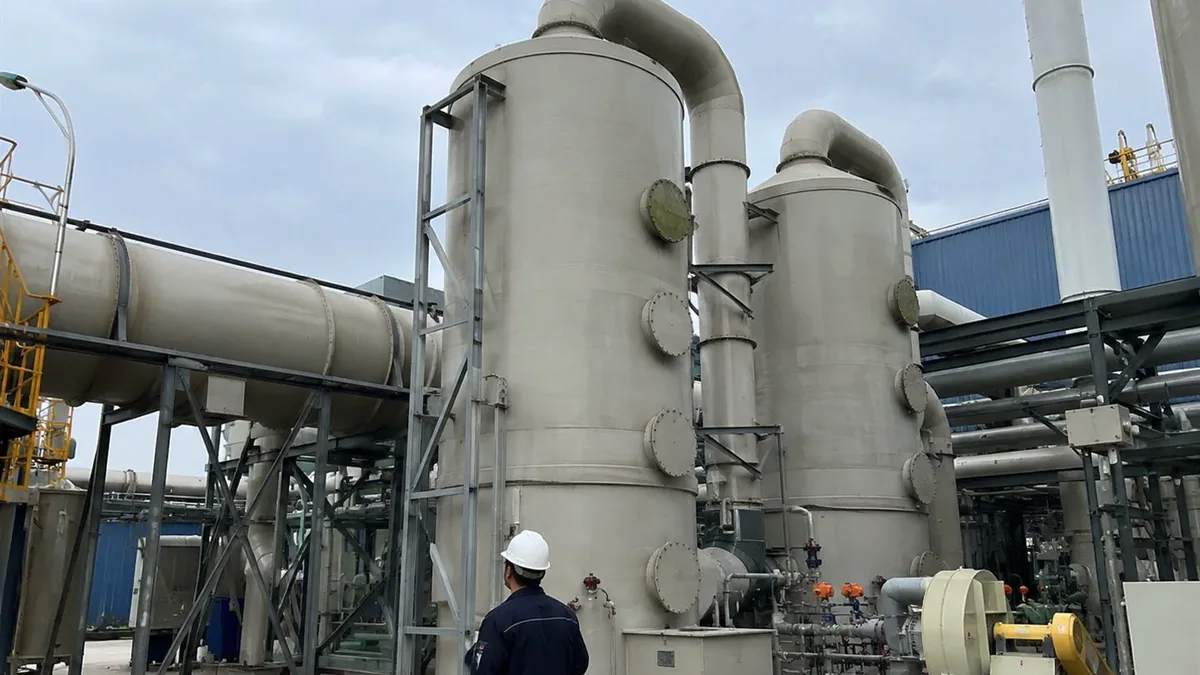
1. Unimpregnated Virgin Extruded Pellet Carbon (1.5 to 4.0 wt% H2S)
Steam-activated bituminous coal pellets (3.0 mm or 4.0 mm) offer strong micropore volume (ASTM D4607 iodine 900 to 1,050 mg/g, ASTM D3467 CTC 60% to 70%, TDS hub). However, H2S is a small, low-boiling gas (MW = 34.08 g/mol, boiling point -60.2 deg C). It shows weak van der Waals attraction on non-polar carbon walls.
Without chemical impregnants, virgin pellet activated carbon holds only 1.5 to 4.0 wt% H2S (0.01 to 0.02 g H2S/cm3). Specify virgin pellets only for trace < 20 ppmv H2S polishing or for trapping siloxanes (D4/D5) after a primary H2S vessel.
2. Caustic KOH / NaOH Impregnated Pellet Carbon (And the Biogas CO2 Trap)
Caustic-Impregnated Pellet Activated Carbon is extruded coal carbon loaded with 4 to 10 wt% potassium hydroxide (KOH) or sodium hydroxide (NaOH) to neutralize acid gases via chemisorption (TDS specs).
Inside a moist alkaline pore film (pH > 12), KOH ionizes H2S into bisulfide (HS-) and sulfide (S2-) ions. Those ions oxidize into elemental sulfur (S) and potassium sulfate (K2SO4).
- Alkaline Dissociation:
H2S + KOH -> KHS + H2O(fast ionic capture in the pore water film). - Partial Oxidation to Sulfur:
2KHS + O2 -> 2S (solid) + 2KOH(regenerates part of the hydroxide base). - Sulfate Salt Formation:
H2S + 2O2 + 2KOH -> K2SO4 + 2H2O(consumesKOHpermanently at lowH2Slevels).
In oxygen-rich wastewater odor scrubbers (< 0.1 vol% CO2), KOH pellets reach 12 to 20 wt% H2S capacity (0.08 to 0.12 g/cm3) per DXD Carbon TDS data. In anaerobic biogas (35 to 45 vol% CO2 per EPA AgSTAR), CO2 attacks the base (2KOH + CO2 -> K2CO3 + H2O). Within 24 to 72 hours, carbonate salts plug the pores and cut usable H2S capacity by 40% to 60% (COA test guide).
3. Potassium Iodide (KI) Catalytic Pellet Carbon (20 to 35+ wt% H2S in High-CO2 Biogas)
KI-Catalytic Pellet Activated Carbon is non-alkaline extruded carbon impregnated with 1.0 to 3.0 wt% potassium iodide (KI) that oxidizes H2S into solid S8 sulfur inside mesopores without CO2 deactivation (pellet catalog).
Because KI is a neutral halide salt, it does not react with 35 to 45 vol% CO2 in digester gas (EPA LMOP). Dissolved iodide (I-) and triiodide (I3-) ions work as a redox shuttle inside the pore water film.
- Redox Shuttle Initiation: Trace oxygen (
0.2 to 0.5 vol% O2, EPA AgSTAR) oxidizesI-on the carbon surface into activeI2 / I3-complexes. - Selective Sulfide Oxidation:
H2S (aq) + I3- -> S (solid) + 3I- + 2H+(convertsH2Swhile regeneratingI-catalyst). - Sulfur Ring Polymerization: Atomic sulfur forms dense cyclo-octasulfur rings (
S8, solid density2.07 g/cm3) inside2 to 50 nmmesopores.
Solid S8 takes far less pore volume than hydrated K2SO4 salts, and KI suffers zero CO2 poisoning. Consequently, KI 4.0 mm pellets store 20 to 35+ wt% H2S (0.12 to 0.22 g H2S/cm3 per ASTM D6646 in our TDS hub) before 5 ppmv slip.
Controlling Relative Humidity (50% to 70% RH), Oxygen Stoichiometry, and Bed Exotherms
Even premium KI or KOH pellet carbon loses capacity if gas moisture, oxygen, or temperature drift out of range.
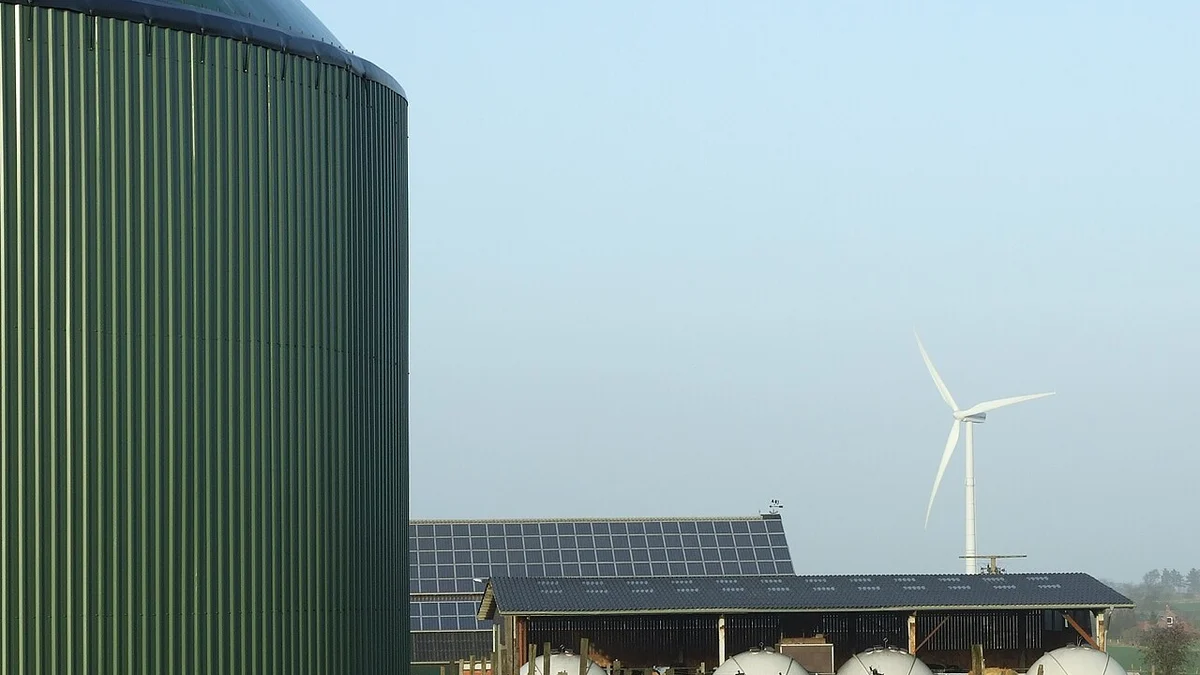
Superficial Linear Gas Velocity is volumetric gas flow divided by empty vessel cross-sectional area (m/s), governing bed pressure drop and mass-transfer zone length.
1. The 50% to 70% RH Non-Condensing Water-Film Window
Catalytic H2S oxidation takes place inside a microscopic water film (2 to 5 molecular layers) on the mesopore walls. Both dry gas and liquid condensate ruin scrubber efficiency.
- Too Dry (
< 35% to 40% RH): Without pore water,H2Scannot ionize intoHS-, dropping reaction speed by over50%(US EPA CATC). - Too Wet (
> 80% RHor Liquid Droplets): Capillary water floods< 2 nmmicropores and2 to 50 nmmesopores (EPA Dairy Guide). Liquid water slows gas diffusion by10,000xand washes solubleKIorKOHsalts out of the bed.
Raw digester gas exits the tank at 35 to 38 deg C and 100% RH per US EPA Dairy Biogas Guides. Cool the raw gas in a 4 to 7 deg C chiller with a knockout demister first. Next, use blower compression heat or an inline heater to warm the gas by 8 to 12 deg C. That temperature rise locks inlet humidity at 55% to 65% RH (industrial gas guide).
2. Oxygen (O2) Stoichiometry vs. Strict Anaerobic RNG Specs
Oxidizing H2S to sulfur (H2S + 0.5 O2 -> S + H2O) needs 0.5 moles of O2 per mole of H2S in theory. Fixed beds need 2.0 to 4.0 moles of O2 per mole of H2S (0.2 to 0.5 vol% O2 for 500 to 1,000 ppmv H2S) per EPA AgSTAR. Most CHP digesters already hold 0.2 to 0.6 vol% O2 from headspace micro-aeration.
Pipeline Renewable Natural Gas (RNG) grids, however, often cap O2 <= 10 to 100 ppmv, banning air injection. For anaerobic (0.00% O2) biogas, specify copper-oxide (CuO / ZnO) impregnated pellets from our pellet product line. Metal oxides bind H2S directly into insoluble copper sulfide (CuO + H2S -> CuS + H2O) at 14 to 24 wt% capacity without oxygen.
3. Bed Exotherm Safety (Delta H = -221 kJ/mol H2S) and Self-Heating Prevention
Catalytic H2S oxidation to elemental sulfur is strongly exothermic (Delta H = -221 kJ/mol H2S, or 6.48 MJ/kg H2S). Oxidation to H2SO4 releases -790 kJ/mol. In an adiabatic bed, every 1,000 ppmv (0.10 vol%) of H2S oxidized raises gas temperature by 12 to 18 deg C.
If inlet H2S exceeds 2,500 to 3,000 ppmv with high oxygen (> 1.5 vol% O2), hotspots can reach sulfur ignition (~232 deg C) or carbon self-heating (~180 to 220 deg C). Per US EPA Clean Air Technology Center Adsorber Guidelines, keep carbon scrubber inlet H2S <= 1,500 to 2,000 ppmv. Use a biological scrubber upstream for higher loads, and install bed thermocouples with a nitrogen (N2) quench line.
Worked Sizing Calculation: 500 Nm3/h Biogas Lead-Lag Adsorber Vessel
Consider a sludge digester generating 500 Nm3/h of conditioned biogas (28 deg C, 60% RH, 38 vol% CO2, 0.35 vol% O2 per EPA AgSTAR). For example, inlet H2S is 400 ppmv (608 mg/Nm3) and the CHP engine requires <= 5 ppmv H2S outlet gas.
Following our extruded pellet diameter selection guide, we select 4.0 mm pellets (apparent density 480 kg/m3). Each lead-lag vessel measures 1.00 m in diameter and 2.50 m in bed height (1.96 m3 = 940 kg carbon per vessel). At 500 Nm3/h, linear velocity is 0.18 m/s, empty bed contact time (EBCT) is 14.1 seconds, and clean pressure drop is < 1.2 kPa.
Daily H2S load entering the lead vessel is 500 Nm3/h * 24 h/d * 0.608 g/Nm3 = 7.30 kg H2S/day (2,663 kg H2S/year). For instance, compare annual media consumption across all three grades below.
Sizing & OPEX Metric (500 Nm3/h, 400 ppmv H2S, 38% CO2) |
Virgin 4.0 mm Extruded Pellet |
Caustic KOH 4.0 mm Pellet |
Catalytic KI 4.0 mm Pellet |
|---|---|---|---|
Effective Field H2S Capacity (wt% in 38% CO2) |
2.5 wt% (0.012 g/cm3) |
9.0 wt% (CO2-degraded from 16%) |
24.0 wt% (0.115 g/cm3) |
Total H2S Captured per 940 kg Vessel Charge |
23.5 kg H2S |
84.6 kg H2S |
225.6 kg H2S |
Service Life per Lead Vessel Charge (7.30 kg/d) |
3.2 days (unviable) |
11.6 days |
30.9 days (37 days lead-lag) |
| Vessel Media Changeouts Required per Year | 113.3 charges/yr |
31.5 charges/yr |
11.8 charges/yr (9.9 lead-lag) |
Annual Activated Carbon Consumption (MT/yr) |
106.5 MT/yr |
29.6 MT/yr |
11.1 MT/yr (62.5% reduction vs KOH) |
| Annual Labor & Spent Media Disposal Burden | Extreme | High (~2.6 swaps/month) |
Low (< 1 swap/month) |
Switching from KOH pellets to KI catalytic pellets in high-CO2 biogas cuts carbon use by 62.5% (from 29.6 MT/yr to 11.1 MT/yr per DXD sizing data). That upgrade saves 18.5 metric tons of media, freight, and changeout labor every year.
Specifying DXD Carbon Virgin, KOH, and KI Impregnated Pellet Grades for Biogas Scrubbers
At DXD Carbon (Ningxia Yongruida Carbon Co., Ltd., founded in 1990 in Shizuishan, Ningxia), our 50,050 m2 manufacturing plant (10,000+ MT/year output) runs hydraulic extruders, rotary activation kilns, and vacuum-spray impregnation drums. Export shipments via Henan Dingxinda Import & Export Co., Ltd. include batch ASTM D3467 CTC, ASTM D3802 hardness, and ASTM D6646 H2S breakthrough testing.
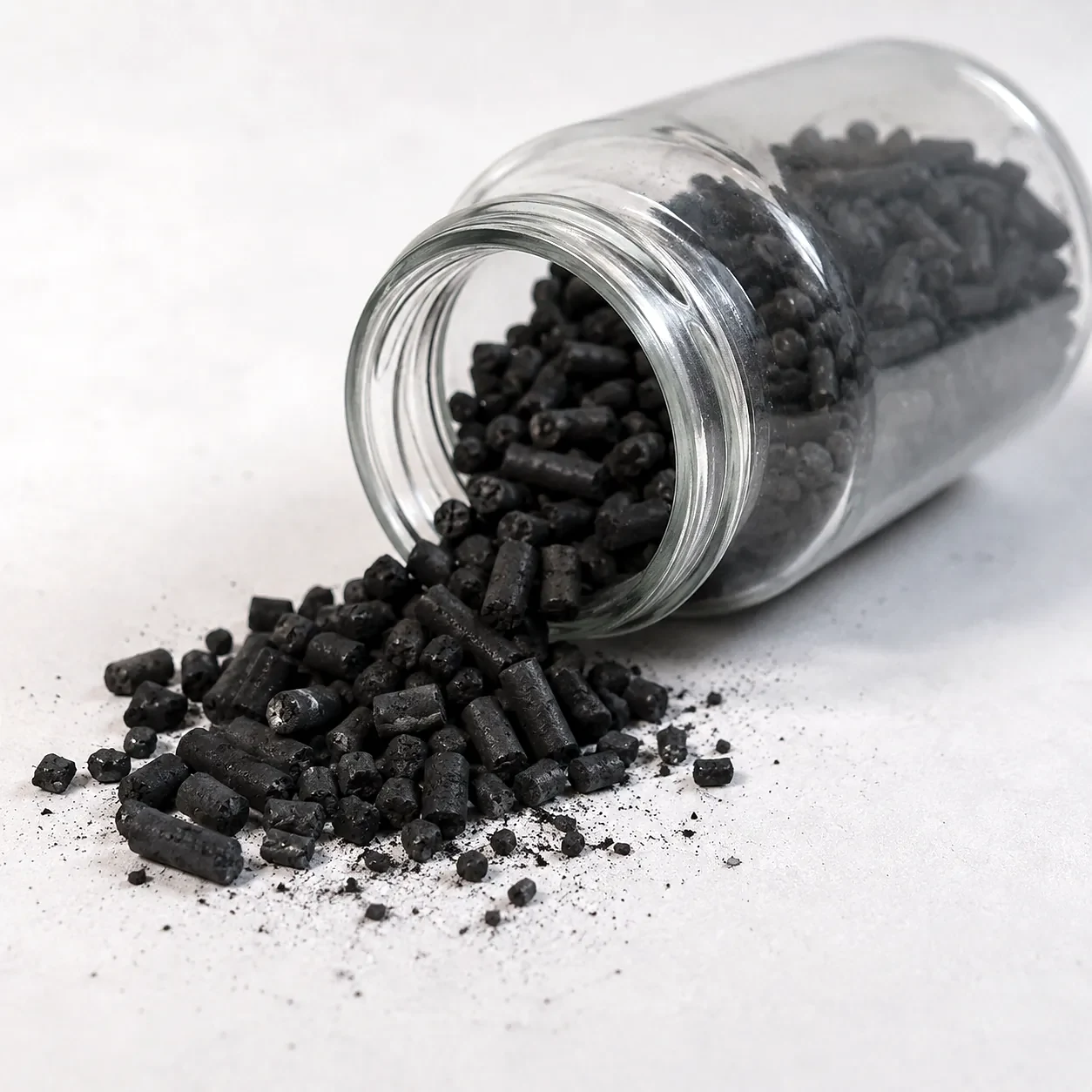
Match your biogas scrubber or odor vessel using our Technical Data Sheets (TDS) hub and our Calgon, Norit, and Jacobi cross-reference guide.
| DXD Carbon Pellet Grade | Pellet Diameter (mm) |
Impregnant & Base CTC | ASTM D6646 H2S Capacity |
International Brand Cross-Reference | Target Gas Stream |
|---|---|---|---|---|---|
| Virgin Extruded Pellet Carbon | 3.0, 4.0 |
Virgin Bituminous (CTC >= 60-70%) |
0.01-0.02 g/cm3 (2-4 wt%) |
Norit RB 3 / RB 4, Calgon AP4-60, EcoSorb GX |
Siloxane (D4/D5) & VOC guard bed |
| Caustic KOH / NaOH Impregnated Pellet | 3.0, 4.0 |
5-8 wt% KOH / NaOH (CTC >= 60%) |
0.08-0.12 g/cm3 (14-20 wt%) |
Norit RB 4W, Jacobi EcoSorb C-KOH, Calgon Centaur |
Municipal sewage air odor (< 0.1% CO2) |
| Catalytic KI Impregnated Pellet | 3.0, 4.0, 6.0 |
1.5-3.0 wt% KI (CTC >= 65%) |
0.14-0.22 g/cm3 (22-35 wt%) |
Norit RGM 3 / RB4 KI, Jacobi AddSorb Sulfox, EcoSorb GX-K |
High-CO2 digester & landfill biogas (>= 0.2% O2) |
| Custom CuO / ZnO Anaerobic Pellet | 3.0, 4.0 |
6-10 wt% CuO / ZnO (CTC >= 55%) |
0.09-0.14 g/cm3 (16-24 wt%) |
Jacobi AddSorb VA3, Norit RGM 1, SulfaTrap |
Strictly anaerobic RNG biomethane (0.00% O2) |
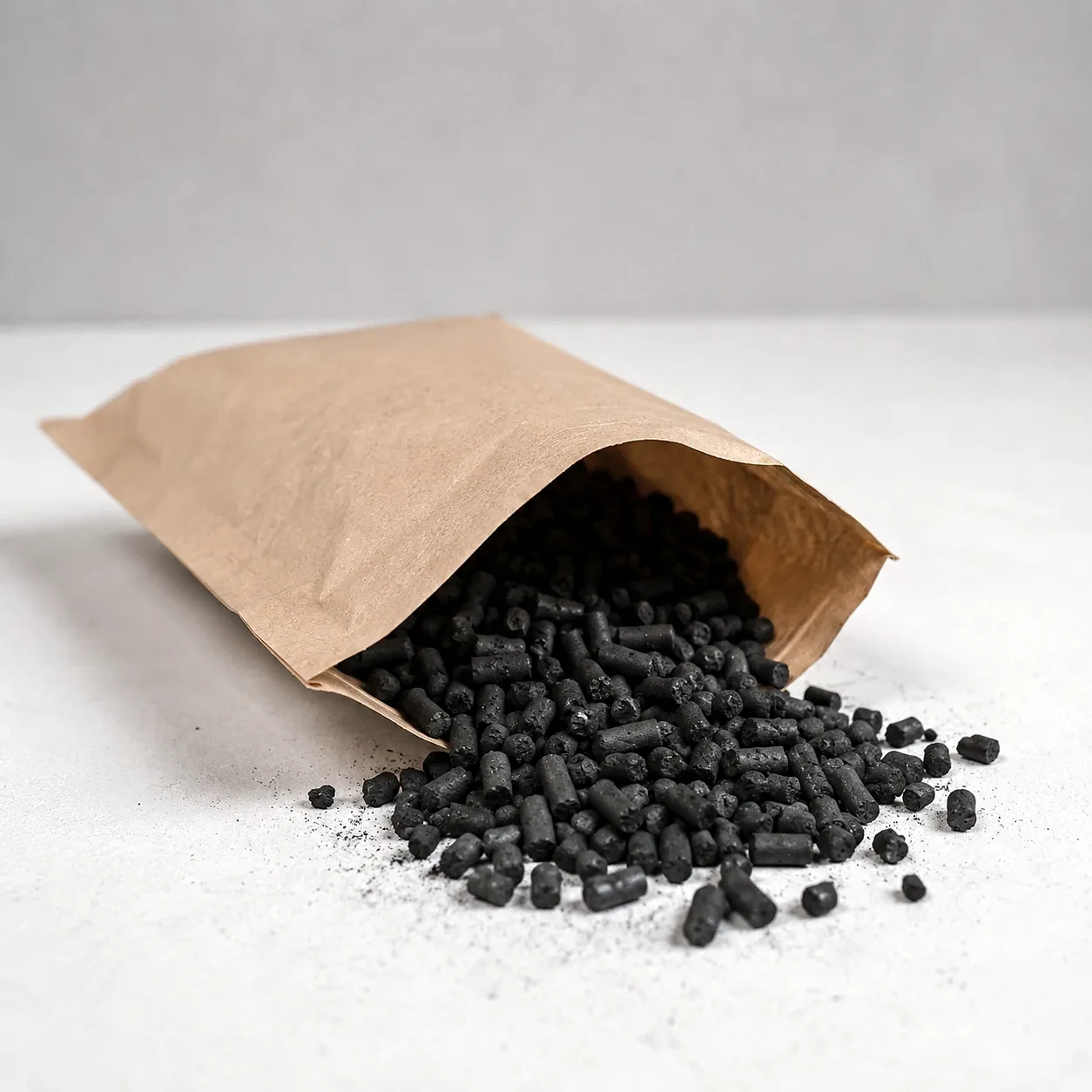
Procurement & RFQ Checklist (MOQ 1.0 Metric Ton)
When replacing imported sulfur media (see our Calgon alternatives guide and Jacobi alternatives guide), share these five parameters on our engineering contact page.
- Complete Biogas Composition: State flow rate (
Nm3/h), inlet and outletH2S(ppmv),CO2(vol%), andO2(vol%). Note if siloxanes (D4/D5) require a second layer of coal-based GAC or coconut shell GAC. - Inlet Temperature & Relative Humidity (
RH): Confirm that a chiller-reheater skid holds50% to 70% RHat20 to 35 deg Cahead of the scrubber (EPA Dairy Guide). - Pellet Diameter & Vessel Hydraulics: Choose
4.0 mmpellets for main biogas vessels (v = 0.15 to 0.35 m/s,EBCT >= 10 to 20 s) to keep pressure drop below1.5 kPa/m. Choose3.0 mmpellets for shallow air purification filters. - Dual COA Verification: Request batch COA reports per our GB/T vs. ASTM COA guide. Lock in
ASTM D3467CTC (>= 60%),ASTM D3802hardness (>= 95%), andASTM D6646H2Scapacity (g/cm3, TDS specs). - Airtight Export Packaging: Specify
25 kgPE-lined woven bags or500 kgFIBC bulk bags (20GPloads9 to 11 MT;40HQloads20 to 24 MT). Sealed liners stop moisture orCO2uptake during ocean transit.
Frequently Asked Questions
Why does KOH-impregnated activated carbon lose H2S capacity in anaerobic digester biogas?
Anaerobic biogas contains 35 to 45 vol% carbon dioxide (CO2) per US EPA AgSTAR. When CO2 contacts alkaline KOH inside moist pores, it forms potassium carbonate (K2CO3) and bicarbonate (KHCO3), deactivating 40% to 60% of the caustic sites (DXD TDS).
How does KI-impregnated pellet carbon remove H2S without reacting with CO2?
Potassium iodide (KI) is a neutral halide salt that ignores acidic CO2. At 0.2 to 0.5 vol% O2 and 50% to 70% RH, KI oxidizes H2S into solid S8 sulfur rings at 20 to 35+ wt% loading (pellet specs).
What happens if biogas entering an impregnated carbon scrubber is 100% saturated with moisture?
At 100% RH, liquid water condenses inside 2 to 50 nm mesopores and slows H2S diffusion by 10,000x (US EPA CATC). Condensate also leaches soluble KI or KOH salts, so raw biogas should be chilled and reheated by 8 to 12 deg C to hold 55% to 65% RH (EPA Dairy Guide).
Which impregnated activated carbon should be used for oxygen-free RNG biomethane polishing?
Both KOH and KI catalytic carbons need 0.2 vol% oxygen (>= 2:1 O2/H2S ratio) to oxidize H2S (EPA AgSTAR). For anaerobic (0.00% O2) renewable natural gas (RNG) upgrading, specify copper-oxide (CuO / ZnO) impregnated pellets, which bind H2S as solid copper sulfide (CuS) (gas treatment hub).