
Trademark Notice: Calgon Carbon, Filtrasorb, OLC, BPL, Centaur, Cane Cal, and WPH are registered trademarks of Calgon Carbon Corporation (a Kuraray company). DXD Carbon (Ningxia Yongruida Carbon Co., Ltd.) is an independent primary manufacturer and is not affiliated with or endorsed by Calgon Carbon Corporation. All trade names appear strictly for engineering specification comparison.
Plant drawings across North America, the Middle East, and Latin America often list legacy brand codes written into manuals 15 or 20 years ago. When water utilities under U.S. EPA drinking water rules or EPC contractors face long distributor lead times, open tenders allow "or approved equal" media. Swapping a grade based on price and iodine number alone, however, risks backwash media loss, pH spikes, or early breakthrough.
Our adsorption process engineers and lab team at the DXD Carbon Shizuishan plant (50,050 m2 site, 10,000+ MT/year) built this guide. It converts six major reference series into line-by-line RFQ limits. Buyers comparing multiple global brands can check our Calgon, Norit, and Jacobi cross-reference guide. You can also review our Norit alternatives guide and Interactive TDS and COA Center.
| Legacy Reference Grade | Feedstock & Form | Direct-Kiln Manufacturing Specification Match | Core ASTM / GB Matching Parameters | Primary Industrial Application |
|---|---|---|---|---|
| Filtrasorb 300 (F300) | Bituminous Coal GAC (8x30) | Re-Agglomerated Bituminous Coal GAC (8x30 Mesh, 900-950 Iodine) | >= 900 to 950 mg/g Iodine; >= 150 mg/g MB; >= 90% Hardness; d10 0.8 to 1.0 mm | Municipal gravity filters, surface water TOC, wastewater COD |
| Filtrasorb 400 (F400) | Bituminous Coal GAC (12x40) | Re-Agglomerated Bituminous Coal GAC (12x40 Mesh, 1000+ Iodine) | >= 1,000 to 1,050 mg/g Iodine; >= 180 mg/g MB; >= 90% to 93% Hardness; UC <= 1.9 | Pressure vessels for PFOA/PFOS, industrial organics, DBP control |
| OLC 12x40 / OLC AW | Coconut Shell GAC (12x40 / 8x30) | Acid-Washed Coconut Shell GAC (12x40 / 8x30 Mesh, 1000-1100 Iodine) | >= 1,000 to 1,100 mg/g Iodine; >= 96% Hardness; Ash <= 3% (AW, pH 6.5 to 8.0) | Low-TOC groundwater VOCs, short-chain PFAS, RO dechlorination |
| AP4-60 / BPL / Centaur | Extruded Coal Pellet (3mm / 4mm) | 3mm / 4mm Extruded Coal Pellet (CTC 60%+ / KOH-KI Impregnated) | >= 60% CTC (ASTM D3467); >= 23% BWC; >= 95% Hardness; 460 to 520 g/L Density | Deep-bed VOC scrubbers, solvent recovery, biogas H2S control |
| GRC-22 / DG-11 | Pre-Polished Coconut GAC (6x12 / 8x16) | Pre-Attritioned Coconut Gold GAC (6x12 / 8x16 Mesh, 98%+ Hardness) | >= 1,050 to 1,150 mg/g Iodine; >= 98% Hardness (Batch 98.7%); Undersize <= 2% | Agitated CIP/CIL cyanidation tanks and CIC heap-leach columns |
| WPH / CPG / Cane Cal | Coal or Wood PAC (200 / 325 Mesh) | Steam & Phosphoric-Acid Wood PAC (200 / 325 Mesh) | 900 to 1,050 mg/g Iodine; 180 to 220 mg/g MB; >= 95% Caramel A-Grade | Municipal MIB/Geosmin dosing, cane sugar & API decolorization |
Translating Filtrasorb 300 and Filtrasorb 400 Into Bituminous Coal GAC Specs
Re-agglomerated bituminous coal GAC is a granular adsorbent made by milling coal blends, compacting briquettes to form feeder pores, crushing to 8x30 or 12x40 mesh, and steam-activating at 850 to 1,000 degrees Celsius. Filtrasorb 300 and 400 perform well in surface water because they pair micropores with wide 2 to 50 nm transport mesopores and clean backwash layering.
When writing a water tender to replace F300 or F400 under U.S. EPA PFAS drinking water rules, do not substitute unblended anthracite or microporous coconut carbon in high-TOC water. Without >= 150 to 180 mg/g methylene blue capacity, humic acids plug pore mouths and cut PFOA and PFOS bed life by a third.
- Replacing Filtrasorb 300 (8x30 US Mesh): Specify re-agglomerated 8x30 mesh bituminous coal GAC (900-950 mg/g iodine) with ASTM D4607 iodine >= 900 to 950 mg/g. Pair that with methylene blue >= 150 to 175 mg/g (GB/T 7702.6), effective size
d10 = 0.80 to 1.00 mm, uniformityUC <= 1.9, and hardness >= 90%. Its 400 to 460 kg/m3 wetted drained density supports 25% to 35% gravity-basin backwash expansion. - Replacing Filtrasorb 400 (12x40 US Mesh): Specify re-agglomerated 12x40 mesh bituminous coal GAC (1,000+ mg/g iodine) with ASTM D4607 iodine >= 1,000 to 1,050 mg/g. Require methylene blue >= 180 to 200 mg/g, effective size
d10 = 0.55 to 0.75 mm,UC <= 1.7 to 1.9, moisture <= 5% (ASTM D2867), and total ash <= 12% (batch test: 9.8% per ASTM D2866).
Matching OLC 12x40 and OLC AW Coconut Shell GAC for Potable Water and RO Protection
In low-TOC groundwater (< 1.5 mg/L), cartridge production, and reverse osmosis (RO) dechlorination, engineers specify coconut grades like OLC 12x40, OLC 8x30, or OLC AW. Coconut char forms dense slit micropores below 2.0 nm with high hardness that stops black fines downstream.
Two specification traps arise when sourcing bulk OLC alternatives. First, unwashed steam-activated coconut GAC holds alkaline salts that push startup rinse-water pH to 9.2 to 10.5. If your plant feeds RO membranes or lacks acid dosing, specify the acid-washed (AW) option (pH 6.5 to 8.0 per ASTM D3838, ash <= 3.0% wt). Second, check the dechlorination half-length (1.8 to 2.4 cm on 12x40 mesh) on our coconut shell granular activated carbon page. Also verify a tight undersize screen limit (<= 4.0% below 40 mesh per ASTM D2862; DXD batch 2.1%).
Cross-Referencing AP4-60, BPL, and Centaur in Gas-Phase Pellet Scrubbers
Vapor-phase extruded pellet carbon is a cylindrical adsorbent (3.0 mm or 4.0 mm diameter) built to keep static pressure drop low in VOC scrubbers, solvent recovery beds, and biogas towers. Legacy gas specs often list AP4-60 (4 mm pellet, 60% CTC), BPL, or catalytic Centaur grades under U.S. EPA Clean Air Act stationary source controls.
- Replacing AP4-60 in Deep-Bed VOC & Siloxane Towers: Specify 4.0 mm high-activity extruded coal pellet carbon (CTC >= 60%) at
4.0 +/- 0.3 mmdiameter (batch:4.02 mm). Require ASTM D3467 CTC>= 60.0% wt(batch:63.5% wt), ASTM D5742 butane working capacity>= 23.0% wt(batch:24.8% wt), ASTM D3802 hardness>= 95.0%(batch:96.8%), and460 to 520 g/Ldensity. At 0.30 m/s gas velocity, 4.0 mm pellets keep pressure drop near 640 Pa/m. - Replacing Centaur or Impregnated Odor Media: When hydrogen sulfide (
H2S), mercaptans, or acid gases appear in moist sewage air or biogas (40% to 80% RH), virgin pellets saturate fast. Specify alkali- or iodide-impregnated 4.0 mm extruded pellet carbon (KOH,NaOH, orKIimpregnation on a>= 60% CTC4.0 mm base), giving>= 0.15 to 0.25 g H2S / cm3capacity.
Specifying GRC-22 and DG-11 Alternatives for Gold CIL/CIP Circuits
Gold mines running Carbon-in-Leach (CIL), Carbon-in-Pulp (CIP), and Carbon-in-Column (CIC) circuits lose bullion whenever weak carbon edges shear off in agitated tanks. Fine carbon chips loaded with gold (2,000 to 8,000 g Au / MT) slip right through 0.7 to 0.8 mm interstage screens into tailings.
Pre-attritioned gold recovery carbon is high-density coconut GAC tumbled and air-classified at the factory to round sharp edges and strip flat flakes before bagging. Check our gold recovery activated carbon line and CIL/CIP gold carbon selection guide when qualifying GRC-22 or DG-11 alternatives. Always lock in three COA floors:
- ASTM D3802 Ball-Pan Hardness: Minimum
>= 98.0%contract floor (DXD batch test:98.7%), verified alongside stirred-pulp attrition checks. - Platelet-Free Sieve Retention (ASTM D2862): Choose
6x12(3.35 to 1.70 mm),6x16(3.35 to 1.18 mm), or8x16(2.36 to 1.18 mm) US mesh. Keep undersize fines strictly<= 2.0% to 3.0% wt(DXD batch test:1.4% wt). - Gold Adsorption Kinetics (
K-Value) & Capacity (R-Value): Specify high micropore volume (>= 1,050 to 1,150 mg/giodine,>= 55% to 60%CTC). High kinetics let fresh carbon out-compete preg-robbing clays in lead tanks and strip cleanly in Zadra or AARL elution columns.
Four-Stage Blind Qualification Protocol Before Full Container Orders
Buyers should never switch a 20-ton plant vessel to a new mill without running a structured lab gate. Note that regulated medical, pharmacopeial, or permit-locked plants legally bound to an approved vendor list must keep buying that registered brand until formal change-control testing clears. For open industrial and municipal specs, run this four-stage audit:
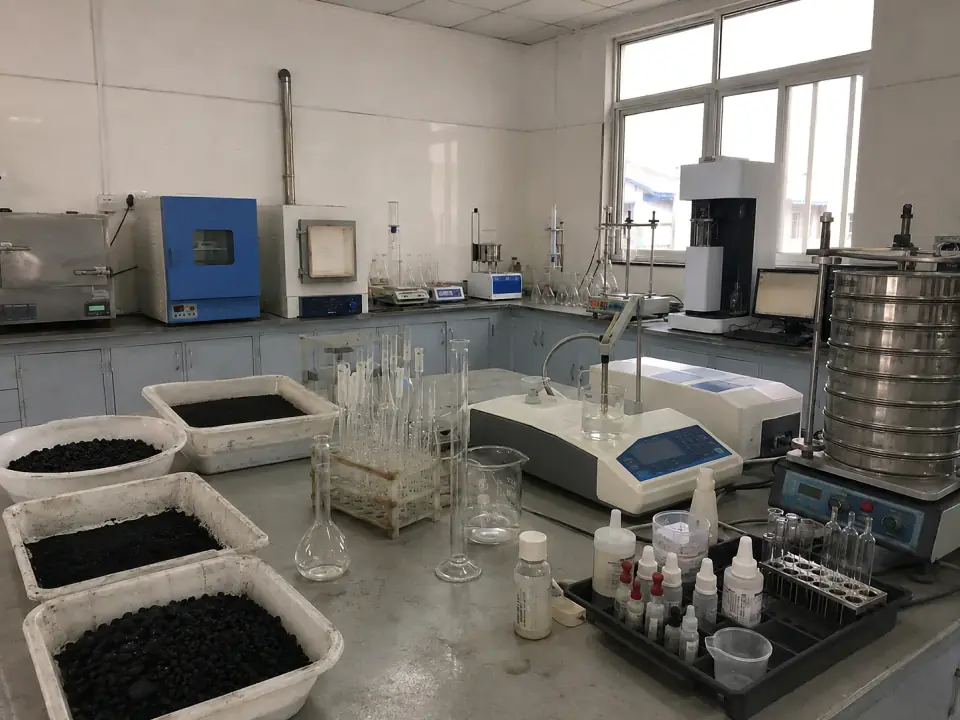
- ASTM vs. GB/T Method Alignment: Confirm that the mill COA tests iodine at the exact ASTM D4607 filtrate normality (
C = 0.02 N) and hardness via ASTM D3802 ball-pan impact. Check full titration steps in our ASTM activated carbon laboratory testing guide. - 500 g Pre-Shipment Sample Blind Split: Request a 500 g to 2 kg kiln sample (
DXD Carbonships free lab samples). Split the unlabeled sample between your plant lab and an independent lab alongside your reference carbon. - Dynamic Column or Jar Benchmarking: Run Rapid Small-Scale Column Tests (RSSCT) for water GAC, or four-point jar isotherms at 60 to 85 C for decolorization PAC under U.S. FDA food ingredient rules. For gold circuits, run parallel cyanidation bottle-roll kinetic trials.
- Lot-Locked Proforma COA Contract: Write hard rejection floors (iodine, MB or CTC, hardness, ash, moisture, and mesh limits) right into the purchase order. Require sealed pre-loading retention samples for every container.
Specifying Direct-Kiln DXD Grades Across All Six Product Lines
At our 50,050 m2 complex in Shizuishan, Ningxia (10,000+ MT/year output since 1990), we run rotary carbonization (450 to 600 C) and steam activation (850 to 1,000 C) under ISO 9001 quality control. Skipping trading brokers stops grade mixing and gives direct kiln-lot traceability across all six DXD activated carbon product lines.
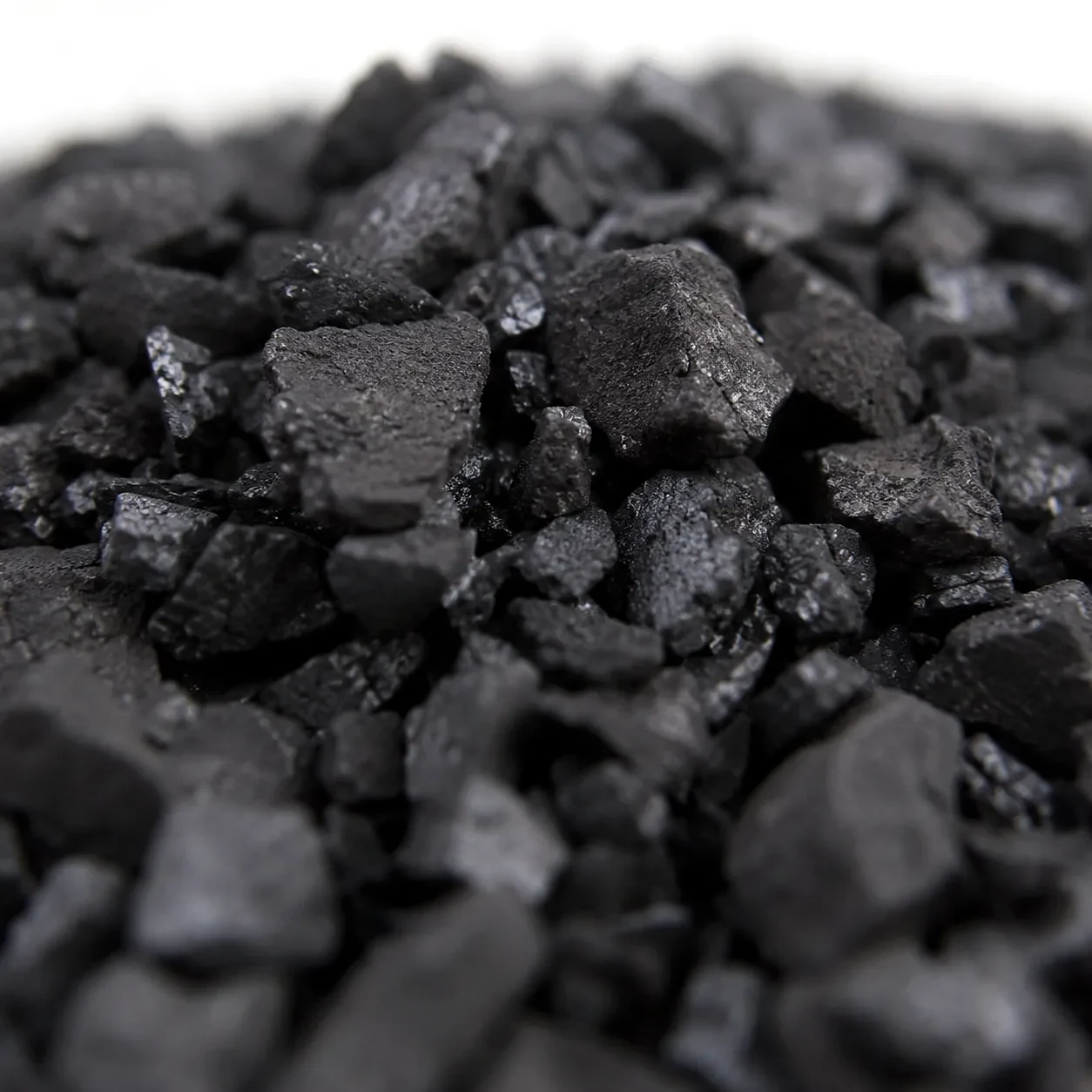
For municipal and industrial water contactors, our coal GAC and acid-washed coconut GAC lines match the transport pores, effective size, and backwash expansion curves needed in standard filter designs. Review vessel hydraulics on our water treatment application hub.
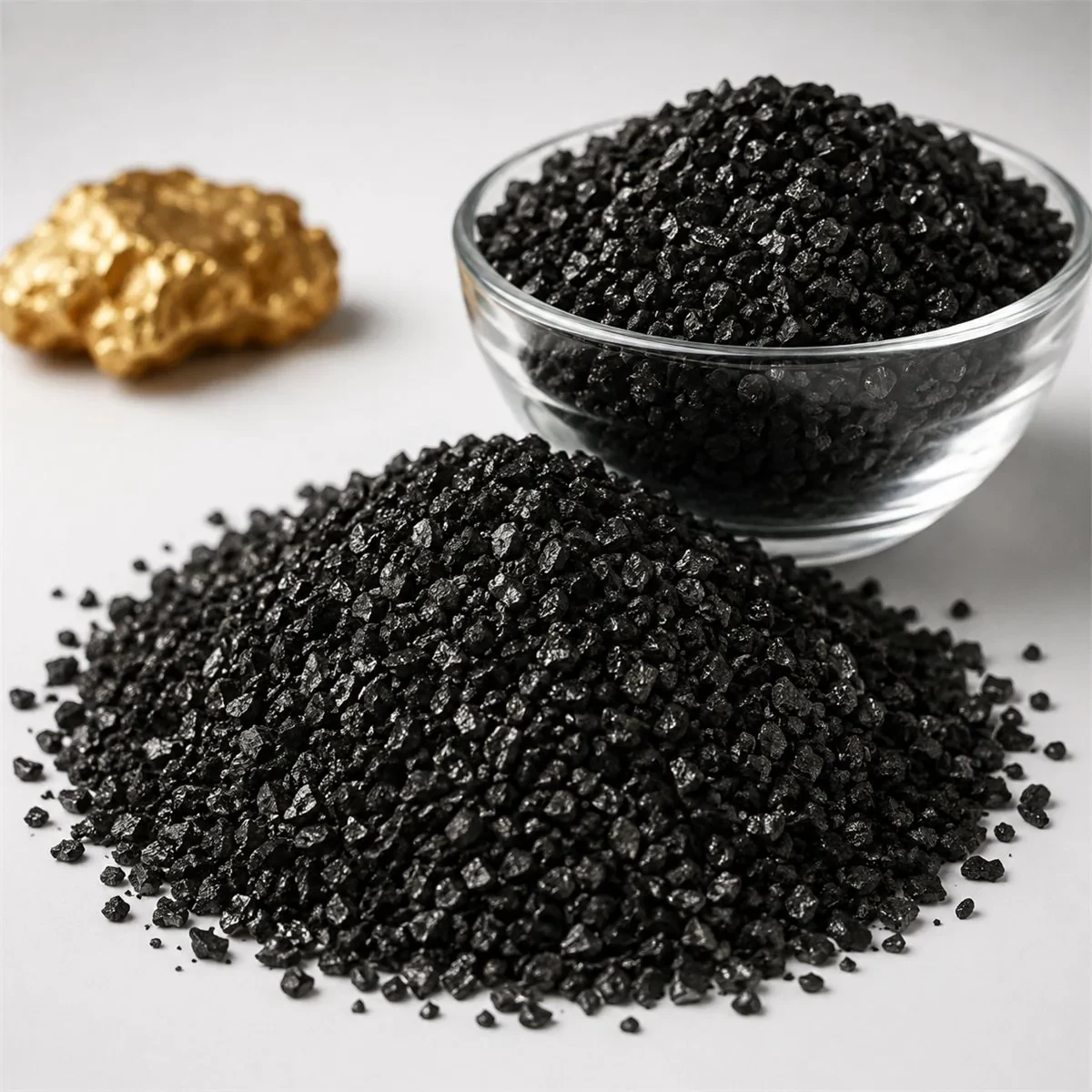
For gold leach circuits, VOC scrubbers, and sugar refineries, we supply pre-polished gold carbon (98.7% hardness), 1.5 to 8.0 mm pellets (63.5% CTC), and wood-based PAC (195 mg/g MB). Process engineers can check operating parameters on our air purification hub and food and beverage decolorization hub.
FCL Container Economics, Packaging, and Repeat-Lot Traceability
Buying direct-from-kiln activated carbon in full container loads (FCL) typically cuts landed media cost by 25% to 40% compared with regional distributor repackaging.
- Packaging Options: Choose 25 kg kraft or PP woven bags with heat-sealed inner PE liners on shrink-wrapped pallets. For pneumatic or hopper loading, choose 500 kg and 1,000 kg UV-stabilized FIBC super sacks with top and bottom spouts.
- 20GP vs. 40HQ Stowage Math: One
20GPcontainer holds 9 to 11 metric tons of GAC or pellets. One40HQcontainer holds 20 to 24 metric tons on 20 to 22 export pallets, cutting ocean freight per ton in half (1.0 MT trial MOQ). - Export Documentation Pack: Every order ships with a lot-specific ASTM/GB COA, TDS, SDS, ISO 9001 certificate, and UN self-heating test paperwork for steam-activated sea freight. Contact our engineering desk with your reference grade and flow rate for a side-by-side spec crosswalk and free sample.